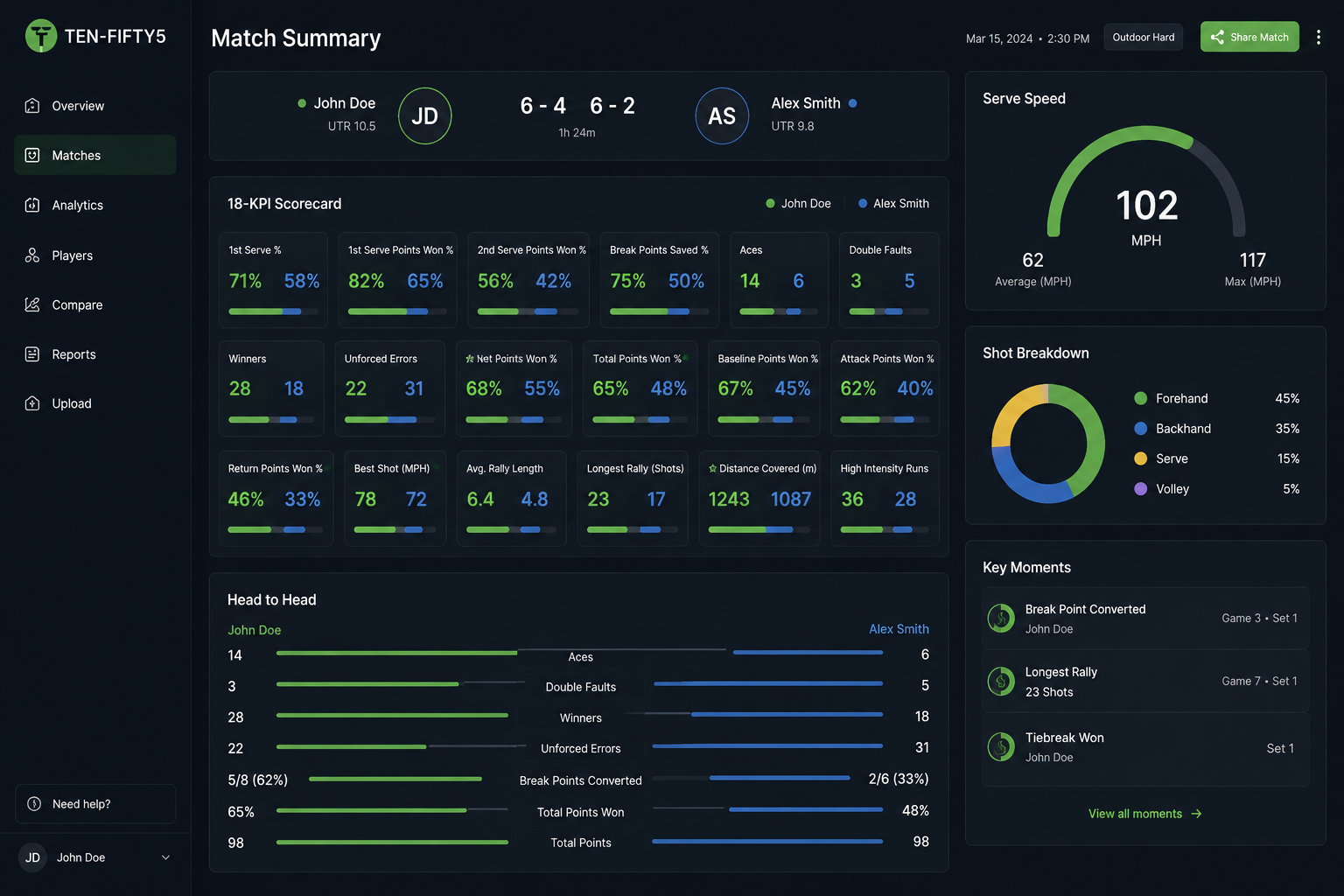
Tennis coaching hasn't changed much in decades. A player hits, a coach watches, and feedback comes through experience, instinct, and whatever the coach can remember from the last set. It works — but it's limited by what one person can observe, recall, and communicate in real time.
AI is starting to change that equation. Not by replacing coaches — the best human coaches bring emotional intelligence, motivation, and contextual judgment that no algorithm matches — but by giving players and coaches access to match data that simply didn't exist at the recreational level before.
Here are five ways an AI tennis coach is shifting how serious club players and competitive juniors train, prepare, and improve in 2026.
1. Personalised Game Plans Based on Your Actual Match Data
The biggest shift AI brings to tennis coaching is specificity. Generic advice — "get more first serves in," "be more aggressive on short balls," "come to the net more" — isn't wrong, but it's not built for you. It doesn't know that your first-serve percentage is actually fine at 62%, but you only win 44% of points on your second serve. It doesn't know that you win 71% of rallies lasting four shots or fewer, but your win rate drops to 38% when rallies go beyond nine shots.
An AI tennis coach that's grounded in your own match data can spot these patterns and build recommendations around them. Instead of "work on your serve," you get "your ad-court wide serve wins 73% of points — but you only use it 18% of the time. Increase that usage in pressure games." Instead of "be more aggressive," you get "your attack-to-defence ratio drops from 1.4 in the first set to 0.7 in the third — you're becoming passive as matches wear on."
That level of specificity used to require a touring coach reviewing hours of footage. Now it comes from uploading a match video.
2. Pattern Detection Across Multiple Matches
One match is a snapshot. Five matches is a story. And that story almost always contains patterns the player can't see from inside it.
This is where AI coaching creates genuine long-term value. By tracking 18 performance KPIs across every match you upload, an AI coach can identify trends that develop slowly — the kind that creep up over weeks or months and are invisible in any single session.
Examples of what longitudinal pattern detection reveals:
- A serve that's quietly deteriorating. Your first-serve percentage was 63% three months ago. It's 54% now. You didn't notice because it dropped 1-2% per month. The AI flags it before it becomes a crisis.
- A rally-length vulnerability that opponents are exploiting. You lose 65% of rallies longer than nine shots. Players who push you into long rallies beat you; players who play your tempo don't. That pattern isn't obvious in any individual match, but across ten matches, it's unmistakable.
- A set-two problem. Your aggression ratio drops consistently in second sets. Not in first sets, not in third sets — specifically in set two. That's not a fitness issue; it's a concentration or tactical pattern worth investigating.
Human coaches can sometimes intuit these patterns, but they're working from memory and notes. AI works from every data point of every match, every time. The two approaches complement each other well — the coach brings judgment, the AI brings total recall.
3. Pre-Match Scouting Without a Scouting Team
At the professional level, players know their opponents inside out before they step on court. Coaching teams review match footage, build scouting reports, and develop game plans tailored to each opponent's patterns.
At the club and junior level, you walk on court knowing almost nothing — maybe you've played them before, maybe a friend mentioned they have a big serve. That's it.
AI is closing that gap. If both you and your opponent use a platform that tracks match data, the AI coach can compare profiles and suggest a tactical approach. But even with only your own data, AI coaching adds value: it knows your patterns well enough to advise which version of your game gives you the best chance.
Playing a pusher who'll extend every rally? The AI knows you win 71% of short rallies and 38% of long ones. The game plan writes itself: shorten points, serve and attack, take time away. Playing someone who hits big but makes errors? The AI knows your defensive rally win rate is strong. Build the plan around consistency and patience.
This isn't hypothetical. It's what happens when match data meets a coaching model that understands your specific strengths and weaknesses. You don't need a scouting team — you need your own data analysed properly.
4. Objective Feedback That Cuts Through Feel
Every tennis player has experienced walking off court after a loss and saying, "I played fine — they just played really well today." Sometimes that's true. Often, the data tells a different story.
One of the most valuable things an AI tennis coach does is separate what you felt from what actually happened. Humans are unreliable narrators of our own performance. We remember the four aces but forget the eight double faults. We think we were aggressive when the numbers show we were neutral. We blame the opponent's level when our own stats dropped sharply from the first set to the third.
AI feedback doesn't have these biases. It looks at 450+ data points per match and reports what happened:
- Your first-serve points won dropped from 72% to 51% between sets.
- You hit 14 unforced errors in the ad court compared to 5 in the deuce court.
- Your rally aggression profile shifted from 60% attack in set one to 35% attack in set three.
That's not criticism — it's clarity. And it's the kind of clarity that lets you ask the right follow-up questions: Why did my ad-court errors spike? Was it footwork? Tactical choices? Fatigue? An AI coach grounded in your data can help you dig into those questions with specifics, not guesses.
5. Democratising Coaching Quality
Here's the uncomfortable truth about tennis development: the quality of analysis you receive is almost entirely determined by how much you can spend. A junior with a private coach and a video analyst gets detailed feedback after every tournament match. A junior without those resources gets "good effort" and a pat on the back.
AI tennis coaching is starting to level that playing field — and this might be its most important long-term impact on the sport.
A club player uploading matches to an AI-powered platform now gets a level of statistical analysis and personalised feedback that simply wasn't available outside professional programmes five years ago. Serve placement heatmaps. Rally-length win-rate analysis. Aggression profiles. Longitudinal performance tracking across an entire season. And an AI coach that can answer "What should I work on this week?" with a specific, data-backed answer instead of a generic one.
Parents of competitive juniors benefit too. Instead of relying solely on a tournament coach's brief post-match debrief, they can review the full match dashboard with their child and track development across months of competition. When it's time to choose a college programme or assess whether training investments are paying off, the data is there — clear, objective, and comprehensive.
The cost of this technology has dropped to a fraction of what a single lesson costs. That matters. When a single match analysis costs less than a can of tennis balls, the barrier to serious, data-driven improvement essentially disappears.
What AI Training Doesn't Replace
It's worth being honest about the boundaries. AI tennis coaching in 2026 is powerful, but it doesn't replace everything a good human coach does:
- On-court feel and adjustment. An AI coach analyses after the match. A human coach can see tension in your shoulders mid-rally and call a timeout to reset your mindset. Real-time emotional coaching remains a human skill.
- Motivation and accountability. Data can tell you what to work on. A person who knows you can tell you how to find the discipline to actually do it, week after week.
- Complex tactical judgment in the moment. "They've started cheating to the forehand side on return — switch to a body serve" is a real-time observation that AI can suggest post-match but not deliver at 4-4 in the third.
The best results come from combining both: AI for comprehensive data analysis and pattern detection, a human coach for on-court guidance, emotional support, and real-time tactical adjustments. The AI handles the breadth of data; the coach handles the depth of relationship.
Where This Is Heading
AI tennis coaching is still early. The tools available in 2026 are significantly more capable than what existed even two years ago — multi-match pattern tracking, natural-language coaching conversations, integrated serve and rally analytics — but they'll look basic compared to what's coming.
Expect to see AI coaches that can simulate opponent strategies before a match, predict fatigue impact based on your performance curves, and integrate with wearable data for a complete picture of physical and tactical performance. The trajectory is clear: more data, better models, and increasingly personalised guidance that makes high-quality coaching accessible to every serious player.
The question for players in 2026 isn't whether AI coaching will become important. It's whether you start building your match data library now — so that when the tools get even better, they have a full season of your patterns to work with.
Start Building Your Data Today
Your first match analysis is completely free — no credit card, no commitment. Upload a match, explore the 18-KPI dashboard, and ask the AI Coach what it sees in your game. You might be surprised by what the data reveals about patterns you've been carrying for years without knowing it.
See your own game in data
Your first match is free — no credit card. Full dashboard, heatmaps, and AI coaching in a couple of hours.
Analyse my first match free