Your serve is the only shot in tennis you have complete control over. No opponent pressure, no time constraints, no unpredictable bounces. And yet, for most club players, it's also the shot they understand least about their own game.
You probably know your serve "needs work" — but what specifically? Is it placement? Speed? Consistency? The ratio between first and second serves? The answer matters, because practising the wrong thing wastes months.
This is where tennis serve analysis comes in. By tracking the right metrics across real matches — not just practice sessions — you can identify exactly what's costing you points and build a targeted plan to fix it. This guide explains what to measure, why it matters, and how modern AI tools make serve analysis accessible to any serious player.
Why Analyse Your Serve? The Numbers That Matter
A strong serve doesn't just win free points. It sets up the entire structure of your service games. Research from professional match data consistently shows that first-serve percentage and first-serve points won are the two strongest predictors of holding serve — more predictive than raw speed, more predictive than ace count.
But here's what makes serve analysis genuinely useful at the club level: the patterns that cost you breaks are often invisible from feel alone. You might feel like your serve was solid in a lost match. The data might show that your placement drifted wide in the ad court under pressure, or that your second-serve speed dropped 15% in the third set, or that you hit 80% of serves to the same zone — making you predictable.
You can't fix what you can't see. Data makes it visible.
The Five Key Metrics of Serve Analysis
1. First-Serve Percentage
This is the foundation. At the professional level, first-serve percentage typically sits between 58% and 68%. Most club players (UTR 5-8) hover around 50-60%, and anything below 50% means you're playing half your service games under second-serve pressure — which compounds quickly.
But the raw number isn't enough. What matters is first-serve percentage in context: does it drop at 30-30? Does it collapse in the second set? Does it differ between deuce and ad court? These patterns tell you whether the issue is mechanical (you need more margin on the toss or swing path) or mental (you tighten up at key moments).
2. Placement Accuracy
Where your serve lands matters more than how hard you hit it. A serve placed on the T at 150 km/h wins more points than a serve smacked into the body at 170 km/h, because geometry forces a weaker return.
Serve placement analysis breaks the service box into zones — typically Wide, Body, and T — and tracks where each serve lands. Over a full match, patterns emerge: maybe you hit 70% of ad-court serves wide, making it trivially easy for your opponent to anticipate. Maybe your T serve on the deuce side wins 75% of points when you use it, but you only go there 15% of the time.
The insight isn't just "where do I serve?" — it's "where do I serve, and where do I win?" Those are different questions, and the gap between them is where improvement lives.
3. Serve Speed (Average and Peak)
Speed is the metric everyone fixates on, but it's the least useful in isolation. A fast serve that goes in 40% of the time is worse than a moderate serve that goes in 65% of the time.
That said, tracking speed over time reveals important trends. If your average first-serve speed drops 10 km/h between the first and third set, that's a fitness or fatigue signal. If your second-serve speed is less than 60% of your first-serve speed, you're likely pushing a cautious second serve that sits up for attackers.
The ratio between first and second serve speed is particularly telling. At the pro level, second serves are typically 75-80% of first-serve speed. At club level, players often drop to 55-65% — essentially hitting a different shot entirely. That gap is exploitable, and seeing the numbers match after match makes it harder to ignore.
4. Points Won on First vs Second Serve
This metric reveals the outcome of your serve rather than the mechanics. Tour-level benchmarks: roughly 70-75% of first-serve points won, 50-55% of second-serve points won.
If your first-serve points won is low despite decent speed, the issue is likely placement or predictability. If your second-serve points won is below 40%, opponents are attacking your second serve effectively — meaning you need either more spin (for higher net clearance and kick), better placement, or slightly more pace to take away their time.
Tracking this across multiple matches shows whether your serve is genuinely improving in match conditions, not just in practice. A 5% improvement in second-serve points won over a season often translates to multiple break-backs per tournament.
5. Biomechanical Consistency
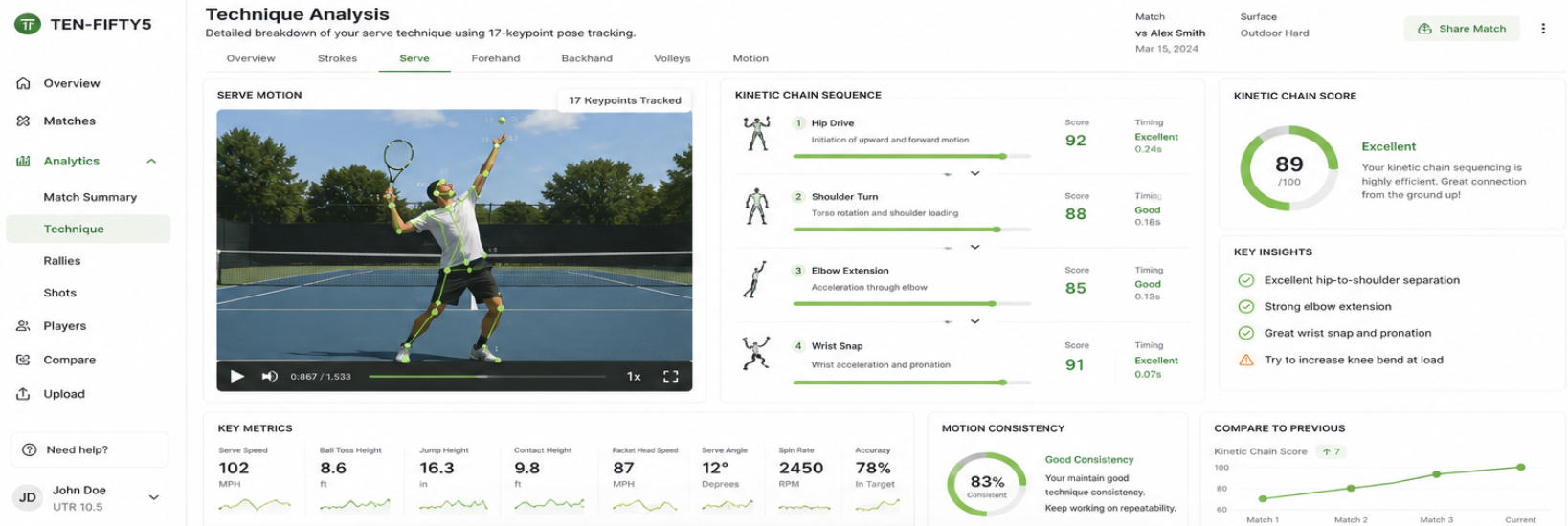
This is the newest frontier in serve analysis, and it's where AI-powered tools are creating the most value for club players. Biomechanical analysis tracks how your body moves during the serve — not just where the ball goes.
Key elements include the kinetic chain (the sequence of energy transfer from legs through hips, trunk, shoulder, elbow, and wrist), trophy position consistency, contact point height, and follow-through path. When these break down — even slightly — both power and accuracy suffer.
The challenge has always been that biomechanical feedback required a trained eye watching in person. A parent filming from the stands can't spot a kinetic chain timing issue. But AI-powered pose tracking can identify exactly where in the chain efficiency is lost, score it against benchmarks, and track whether your technique changes are sticking across matches.
How AI Makes Serve Analysis Accessible
Ten years ago, this kind of serve analysis required either a professional coaching team with video software or expensive on-court sensor systems. Today, AI has made it possible from a single camera recording.
Here's how modern tennis serve analysis works with a platform like Ten-Fifty5:
Record your match with any camera. Phone on a tripod, GoPro behind the baseline, your club's installed camera — anything that captures at 720p or above works. You don't need a special setup or specific device.
Upload and wait. The AI pipeline identifies every serve in the match, classifies landing zones, calculates speeds, and builds heatmaps. Most matches are processed within one to two hours.
Review your serve dashboard. You get serve placement heatmaps broken down by deuce/ad court and first/second serve, win rates per zone, speed data (average and peak), and biomechanical technique scoring. Over 450 data points per match, with 18 tracked KPIs.
Ask your AI Coach. This is where it gets powerful. Instead of staring at charts wondering what they mean, you can ask: "Why am I getting broken more in the second set?" or "Which placement pattern gives me the best hold percentage?" The answers come from your real data — not generic tennis tips from the internet.
What Good Serve Data Reveals: Three Real Patterns
To make this concrete, here are three patterns that serve analysis commonly exposes at the club level — patterns that feel invisible during the match but become obvious in the data:
Pattern 1: The Predictable Server
A player hits 72% of first serves to the same zone (wide on deuce, body on ad). Their opponent reads it by the second set, creeps into position early, and starts attacking returns. First-serve points won drops from 68% in set one to 51% in set three — not because the serve got worse mechanically, but because it became readable.
The fix isn't technical; it's tactical. Vary placement distribution closer to 40/30/30 across zones. The serve heatmap makes this visible in seconds.
Pattern 2: The Second-Set Collapse
First-serve percentage: 64% in set one, 48% in set two. Average speed drops 12 km/h. The player didn't notice because they won the first set comfortably and attributed the second-set loss to "the opponent raised their level." The data tells a different story — physical fatigue or loss of focus degraded the serve, and the opponent simply capitalised on weaker deliveries.
The fix is conditional: either improve physical conditioning, or build a serve motion with more margin that holds up under fatigue.
Pattern 3: The Missing Weapon
A player's T serve on the deuce side wins 78% of points when they hit it. But they only go there on 12% of serves — defaulting to wide 65% of the time, where they win only 58% of points. They're leaving their best weapon unused.
Without placement data and win-rate analysis, this pattern is almost impossible to self-diagnose. With it, the game plan writes itself.
Building a Serve Improvement Plan from Data
Once you have serve analytics from two or three matches, you can build a targeted improvement plan instead of vaguely "working on your serve" at practice. Here's the framework:
Step 1: Identify the bottleneck. Is it consistency (first-serve % below 55%)? Placement (over 60% to one zone)? Power fade (speed dropping more than 10% in later sets)? Second-serve vulnerability (points won below 45%)?
Step 2: Set a specific target. Not "improve my serve" but "increase ad-court T serve usage from 12% to 25% over three matches" or "maintain first-serve speed within 5% between sets one and three."
Step 3: Track progress across matches. This is where longitudinal data becomes critical. One match is a snapshot. Three matches is a pattern. Ten matches is a trend. A platform that tracks your serve metrics over time lets you see whether your practice sessions are translating into match performance — which is the only measurement that actually counts.
Step 4: Use AI coaching for drill design. Based on your specific data, an AI coach can suggest targeted practice drills. If your T serve is your best weapon but underused, the drill plan focuses on building confidence in that placement under pressure — not generic serving practice.
Frequently Asked Questions
Do I need an expensive radar gun to track serve speed?
No. AI-powered analysis platforms can estimate serve speed from standard video. You don't need any special hardware beyond a camera that records at 720p or higher. A phone on a tripod works perfectly.
How many matches do I need before the data is useful?
Even one match reveals actionable patterns — especially placement distribution and zone win rates. But three to five matches gives you reliable trends, and that's when longitudinal tracking becomes powerful.
Can serve analysis help my second serve specifically?
Absolutely. Second-serve analysis often reveals the biggest opportunities at club level: speed that drops too far below first-serve pace, placement that becomes predictable under pressure, and points-won rates that signal opponents are attacking effectively. These are all fixable once visible.
What camera angle is best for serve analysis?
Behind the baseline (slightly elevated if possible) gives the best combination of placement visibility and biomechanical tracking. But side-on works for technique analysis specifically. Most platforms — including Ten-Fifty5 — can work with any standard match-recording angle.
Start Measuring What Matters
Your serve is the one shot you can improve entirely on your own terms. You don't need a hitting partner, you don't need to react to anything, and you don't need to guess what's working and what isn't — not anymore.
Tennis serve analysis turns feel-based guessing into evidence-based improvement. Whether your issue is placement, consistency, power, or biomechanics, the data shows you exactly where to focus — and tracks whether your work is paying off match after match.
Your first match analysis is free. Upload a match, review your serve dashboard, and see what the numbers reveal about the shot you hit more than any other.
See your own game in data
Your first match is free — no credit card. Full dashboard, heatmaps, and AI coaching in a couple of hours.
Analyse my first match free