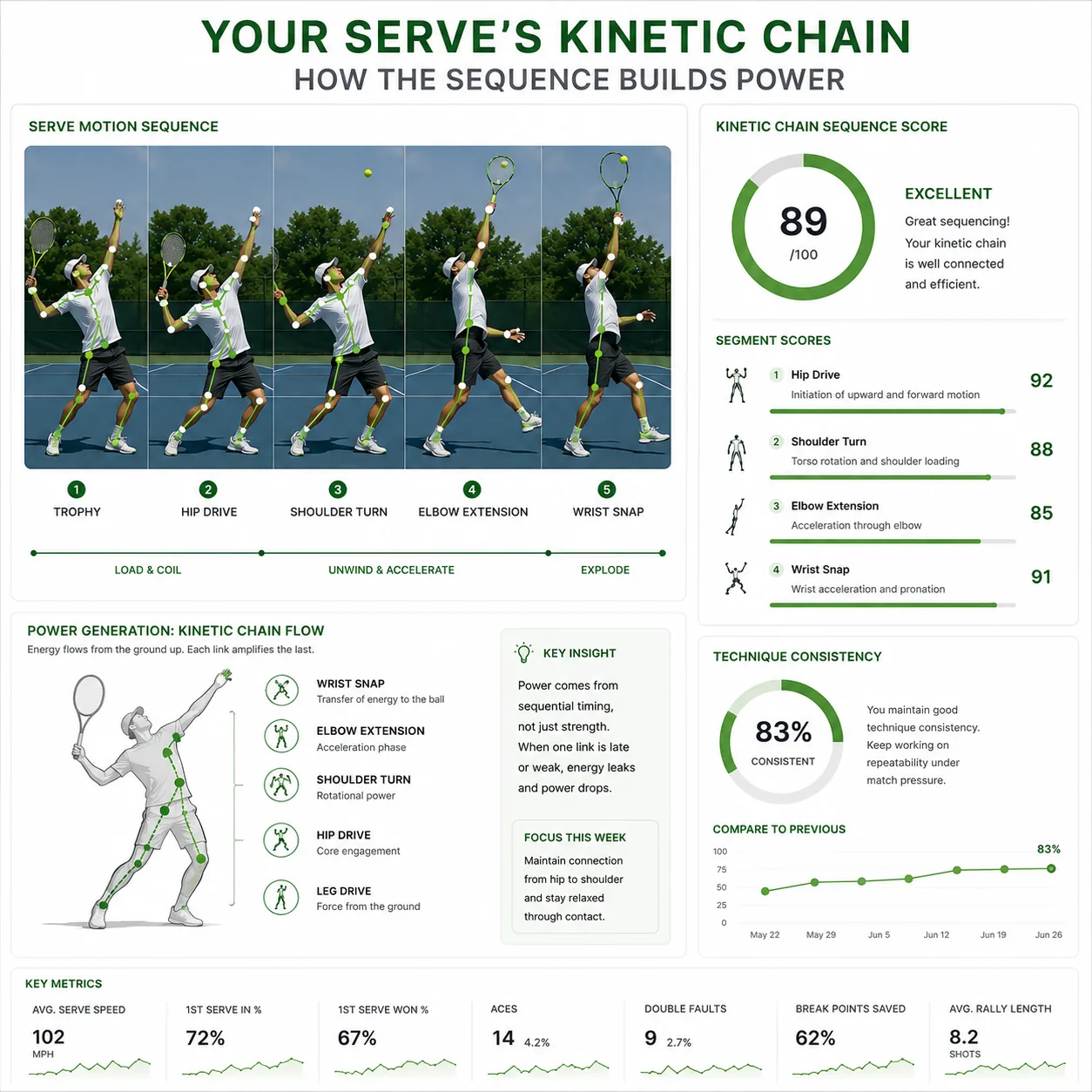
The serve is the one shot you build from the ground up
Every other shot in tennis is a reaction. The serve is the one stroke you start, on your own terms, with all the time in the world. That is exactly why it rewards good mechanics so heavily — and why a serve that looks "fine" can still be leaking power and inviting shoulder trouble.
The thing quietly deciding how fast and how safely you serve is the kinetic chain: the sequence of body segments that pass energy from the court up into the ball. Get the sequence right and a relaxed-looking motion produces surprising racket-head speed. Get it wrong and you end up muscling the ball with your arm, topping out well below your potential, and overloading the one joint you most want to protect.
Here's the encouraging part: the kinetic chain is a pattern, not a talent. You can see it, measure it, and retrain it — and you don't need a sports-science lab to do it. You need a clear picture of the order your body is firing in, which is something modern match and technique analysis can pull straight out of phone footage.
What the kinetic chain actually is
Think of the serve as a whip. A whip cracks because energy travels from the thick handle down to the thin tip, accelerating as it goes. Your body does the same thing, segment by segment, from the biggest and slowest at the bottom to the smallest and fastest at the top:
- Legs — the engine. Knee bend stores energy; the push up off the court converts it into upward force.
- Hips — rotation and drive that transfer leg power into the trunk.
- Trunk / core — the coil. Shoulder-over-hip separation stores elastic energy, then uncoils.
- Shoulder — accelerates the upper arm.
- Elbow and forearm — extension and internal rotation, the biggest single contributor to racket speed at the pro level.
- Wrist — the final snap that delivers it all to the racket and ball.
The golden rule is proximal to distal: ankles → knees → hips → trunk → shoulder → elbow → wrist → racket. Each segment should reach its peak speed after the one below it and before the one above it. When that timing holds, every link adds to the link before it and the racket head arrives at contact moving far faster than your arm alone could ever swing it.
Why the sequence matters more than strength
Most club players who want a bigger serve reach for the wrong fix: they try to swing harder with the arm. It feels powerful and it produces almost nothing, because the arm is the smallest, weakest link in the chain. Real serve speed is built underneath it.
Biomechanics research is blunt about this. When there's a "break" in the lower part of the chain — lazy legs, no hip drive, an early trunk — the upper segments have to overwork to make up the lost force. That's a double penalty: you lose speed and you raise injury risk at the same time, because the shoulder and elbow are now doing a job the legs and hips were supposed to do. Coaching and sports-medicine sources consistently link poor proximal sequencing to overuse shoulder problems.
The flip side is the good news every serious player wants to hear: the power is often already in you, sitting unused in your legs and trunk. Studies of leg-drive and contact-point corrections suggest a large share of recreational players could add meaningful racket-head speed — often cited in the region of 10–18 mph — purely by fixing sequence and leg drive, with no extra gym work. You're not weak. Your chain is just firing out of order.
The four sequencing faults you can actually see
You don't need force plates to spot the common breakdowns. Once you know what to look for, they're visible in any decent side-on video:
- No leg drive. Minimal knee bend, no push up off the court. The serve becomes an upper-body throw. Fix the floor and everything above it has more to work with.
- The "all-arm" serve. The trunk barely rotates and the arm does the work. High effort, low output, and the shoulder pays for it over time.
- Early shoulder, late hips. The shoulder rotates before the hips finish driving, so the segments fight each other instead of stacking. This is one of the most common — and most fixable — faults, and it's exactly the kind of out-of-order peak that shows up when you sequence a serve frame by frame.
- Lost separation. Without shoulder-hip separation (the coil), there's no stored elastic energy to release. The motion looks smooth but produces no whip.
If you're not sure which of these is costing you the most, that's precisely the question data answers better than the mirror. A coach watching live sees the result; frame-by-frame technique analysis sees the order, which is the thing you have to change.
How to read your serve from video
This is where serve improvement has genuinely changed. A few years ago, kinetic-chain analysis meant a university lab, reflective markers and a specialist. Now the same insight comes from a single fixed camera at the back of the court.
Here's a practical way to work through it:
1. Capture clean side-on footage. A phone on a tripod, roughly baseline height, is plenty. You want the whole body in frame through the full motion. (If you want the full setup checklist, our guide on filming a match for analysis covers angle, height and settings.) 2. Watch the order, not the outcome. Don't judge by where the ball lands. Step through the motion and ask: does each segment peak after the one below it? Legs, then hips, then trunk, then shoulder, then arm, then wrist. 3. Find your weakest link. There's almost always one segment doing too little (usually the legs or trunk) and one doing too much to compensate (usually the shoulder or arm). Fix the under-worker first. 4. Score it and re-test. Improvement you can't measure is improvement you'll argue about. Re-film after a few sessions and compare the same checkpoints.
Pose-based technique tools make step two far easier by tracking joints frame by frame and flagging when a segment fires out of order — for example, telling you that your shoulder rotation is peaking slightly before your hips, and that the fix is loading the left hip earlier. That's a single, concrete action, not a vague "use your legs more."
Why match-grounded technique analysis beats a one-off serve clip
Plenty of apps will score a single serve you record in isolation. That's useful, but it isn't how you actually serve in a match — under fatigue, on big points, when the score tightens. The more valuable picture comes from analysing your serve inside real matches over time, so you can see whether your kinetic chain holds up in the third set or quietly falls apart when it matters.
That's the philosophy behind Ten-Fifty5's Technique Analysis: 17-keypoint pose tracking and kinetic-chain sequencing scored against beginner-to-pro benchmarks, sitting alongside your full match analytics rather than in a separate silo. Your serve biomechanics live next to your serve-placement heatmaps and your win-rate-by-zone data, so you can connect how you serve to what it produces. And because it's bundled into every plan rather than locked behind a premium tier, you can track the chain across a whole season — see the plans, or if you work with players, the coach view shows the same technique trend lines across your whole roster.
Train the chain, not the arm
If you take one idea away, make it this: serve power is a sequencing problem, not a strength problem. The fastest, safest serves come from energy that starts at the court and arrives at the racket in the right order. Most of the speed you're missing is already in your legs and trunk, waiting for the chain to fire cleanly.
Find your weakest link, fix the order from the ground up, and re-measure. That's how you add real, repeatable power to the one shot the game lets you fully own — and how you protect your shoulder while you do it.
See your own game in data
Your first match is free — no credit card. Full dashboard, heatmaps, and AI coaching in a couple of hours.
Analyse my first match free