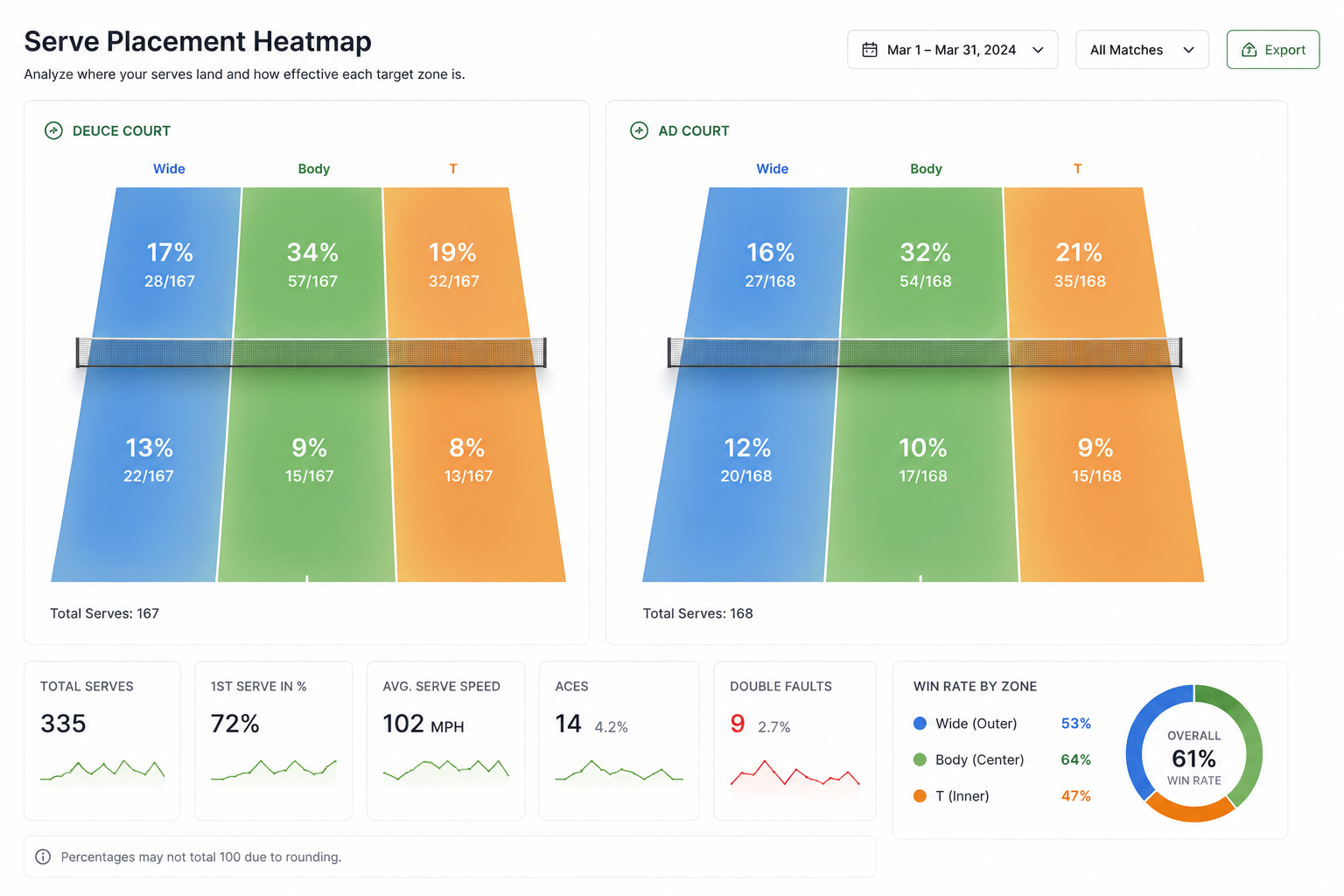
If you only ever measure one thing about your serve, make it placement. Speed is satisfying, but the players who quietly win more service games are usually the ones who can put the ball where they want it — and who know, match to match, whether they actually did. This guide breaks down the three serve placement zones every serious player should master, what each one does to your opponent, and how to read your own serve data so you stop guessing and start building a pattern.
Why placement beats power
Here's the uncomfortable truth from the pro game: a big serve that lands in a predictable spot gets neutralised quickly, while a medium serve placed on command keeps the returner permanently off balance. When you can hit the T, go wide, or jam the body whenever you choose, your opponent can't cheat to one side or settle into a rhythm. They hit off-balance, defensive returns — and a defensive return is the easiest ball in tennis to attack.
That's why placement is the foundation of serve strategy. Power is a multiplier, but only once you own your locations. For serious recreational players and junior competitors, placement is also the faster route to improvement: you don't need another five mph, you need to miss the right targets less often.
The three serve placement zones
Every service box can be thought of as three target areas. Each one solves a different tactical problem.
1. Down the T
The T serve travels toward the centre line, close to where the centre service line meets the service line. Because it's hit through the lowest part of the net and over the shortest distance, the T is the most reliable big-target zone — it's why many advanced players use it even on second serves.
Tactically, the T takes the angle away from the returner. They can't open up the court because there's no width to work with, so their return tends to come back down the middle, right into your strike zone. On the deuce court especially, a T serve to a right-hander's backhand is one of the highest-percentage patterns in the game.
2. Out wide
The wide serve is directed toward the sideline, dragging the returner off the court. Its job isn't always to win the point outright — it's to open space. Once your opponent has to step outside the doubles alley to make contact, the entire opposite court is exposed for your next shot. This is the classic "serve-plus-one" setup: serve wide, then hit into the space they just vacated.
The wide serve is most dangerous when your opponent already respects your T, because the threat of one makes the other harder to read.
3. Into the body
The body serve is the most under-used weapon at club and junior level. Aimed at the returner's hip — for a right-hander, their right hip — it handcuffs them. They can't fully extend their arms, and they have to make a split-second decision: slice a cramped forehand, or jump out of the way to find a backhand. Either way you get a weak, short reply.
The body serve is especially effective against tall returners with long levers, and as a change-up when someone is teeing off on your wide and T serves.
The pattern matters more than any single serve
Knowing the three zones is step one. Winning with them is about variety and intention. A predictable serve — even a well-placed one — eventually gets read. The goal is to keep the returner guessing so they can never commit early.
That means tracking two things over a match, not just one ball at a time:
- Where you intended to serve vs. where it actually landed (your accuracy).
- How balanced your distribution is across T, wide, and body — and whether your win rate differs by zone.
Most players have a "comfort" serve they drift toward under pressure. If 70% of your first serves on big points go to the same corner, good opponents will sit on it. Seeing that bias is often the single most useful thing match data reveals.
How to read your own serve placement data
You can't fix what you can't see. The traditional way to capture this is manual charting — pausing video, marking each serve's location by hand. It works, but it's slow, and almost nobody keeps it up for long.
This is exactly where automated match analysis earns its place. When you upload a match to Ten-Fifty5, the platform detects every serve, marks first and second serves and double faults, and maps where each one landed — then turns it into a placement heatmap and serve-zone accuracy numbers you can actually act on. Instead of a vague sense that "my wide serve felt off today," you get the real split: how often you hit each zone, your make percentage in each, and which zone is winning (or quietly losing) you the most points.
A few questions your serve data should answer after every match:
- What's my zone distribution? Am I genuinely mixing T, wide, and body, or leaning on one?
- Where's my accuracy strongest? Build patterns around your reliable zone, and practise the weak one.
- Which zone wins points? Sometimes your "best" serve by feel isn't your best by results.
- Does my placement hold up on big points? Compare your serve map on break points to the rest of the match.
Track those across several matches and trends appear that no single match could show — your T accuracy climbing month over month, or a wide serve that wins points in week one but gets read by week four.
A simple practice loop
Reading the data is only useful if it changes what you do on court. Try this loop:
1. Upload your match and check your serve-zone accuracy and heatmap. 2. Pick the one zone with the biggest gap between intention and result. 3. Drill it for ten focused minutes at the start of your next session — cones in the target zone, hit until it's muscle memory. 4. Re-check the data after your next match to confirm the zone improved.
Ten focused minutes a session, measured honestly, beats an hour of unmeasured serving. The measurement is what turns practice into progress.
See your own serve, zone by zone
You don't need a sports-science team or a fixed-mount camera to get this. Record one match on whatever camera you have — a phone on a tripod is plenty — and let the analysis do the charting for you.
Your first match is free, no credit card required. Upload a match, get your serve-placement heatmap and zone accuracy, and find out which serve is really winning you points.
Game. Set. Data.
See your own game in data
Your first match is free — no credit card. Full dashboard, heatmaps, and AI coaching in a couple of hours.
Analyse my first match free