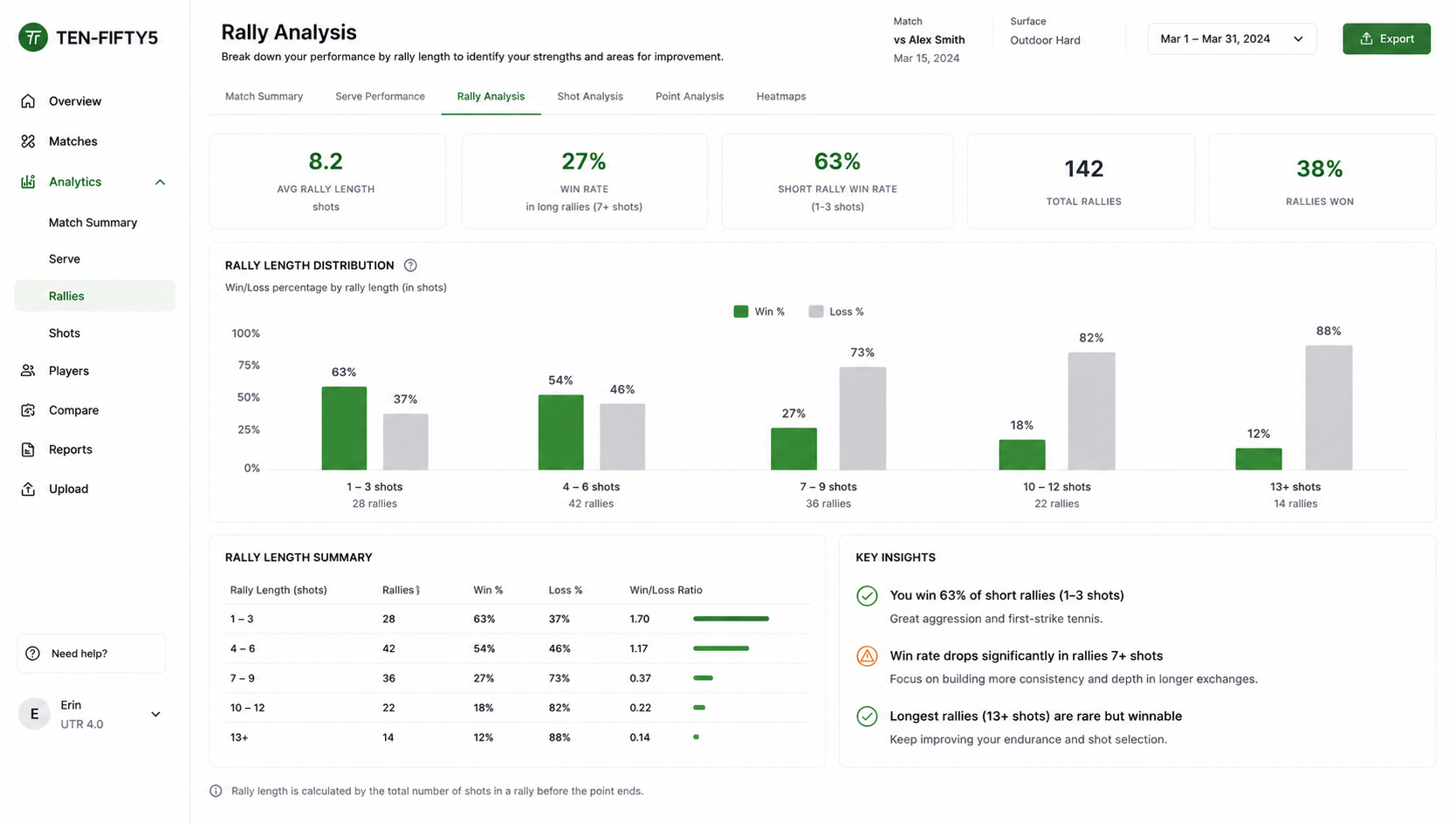
What is a rally in tennis?
A rally in tennis is the exchange of shots between players that follows the serve — every ball hit back and forth over the net until the point ends in a winner, a forced error or an unforced error. A rally's length is simply the number of shots it contains, counting the serve as the first shot.
So an ace is a one-shot rally. A serve, a return and a putaway is a three-shot rally. A long baseline exchange might run to fifteen or twenty shots. The term covers the whole point, not just the baseline phase — which is why commentators use "rally" and "point" almost interchangeably.
That definition sounds trivial. It isn't — because the moment you start counting rally lengths and recording who won each one, the tactical shape of your whole game appears in a way that no amount of watching will show you. That is what rally analysis does.
What rally analysis measures
Rally analysis tracks every point in a match and categorises it by how the rally played out — not just the final result. The two most fundamental dimensions are rally length (how many shots the point lasted) and rally outcome (who won, and how — winner, forced error, unforced error).
From those building blocks, a full rally analysis reveals patterns like your win rate at different rally lengths, how aggressively you play relative to your opponent, whether you control or surrender neutral rallies, and how your patterns shift across sets as a match develops.
Rally Length: The Most Revealing Metric You're Probably Ignoring
Rally length distribution is the single most informative piece of tactical data you can get from a tennis match. It sorts every point into categories based on how many shots the rally lasted — typically grouped as 0-3 shots (serve-plus-one territory), 4-6 shots (short rallies), 7-9 shots (medium rallies), 10-12 shots (extended rallies), and 13+ shots (grinding territory).
Then it shows your win rate in each category.
The patterns this reveals are often surprising. Common profiles at the club level include:
- The Big Server: Wins 70%+ of 0-3 shot rallies but struggles below 40% in 7+ shot rallies. Points end quickly on serve or they're in trouble.
- The Consistent Baseliner: Dominates 7-12 shot rallies at 60%+ but leaks points below 45% on serve and return games.
- The All-Courter: Even win rate across all lengths — adaptable but may lack a dominant pattern.
- The Fader: Strong in set one at 0-6 shots but deteriorates across all lengths by set three.
The key question rally length answers is: "at what rally length do you stop winning more than you lose?" That crossover point defines your tactical identity and reveals exactly what your opponent needs to do to beat you.
The Aggression Profile: Attack, Neutral, and Defence
Rally length tells you how long your points are. Your aggression profile tells you how you're playing within those rallies.
An aggression profile categorises your shots into three modes: attack (taking the ball early, moving forward, hitting with intent to end the point), neutral (maintaining the rally, building position, neither pressuring nor under pressure), and defence (pushed behind the baseline, retrieving, trying to stay in the point).
High attack percentage (above 40%): You're dictating play, but watch the error count. Aggression without accuracy is just gifting points. If your winner-to-unforced-error ratio is below 1:2 alongside high aggression, you're overplaying.
High neutral percentage (above 50%): You're playing a lot of rallies where neither player has the upper hand. This can mean you're solid but passive, or both players are evenly matched. If you're winning neutral rallies at 55%+, you're the better player and can afford patience. If you're losing them, you need to create more attacking opportunities.
High defence percentage (above 30%): You're spending too much time on the back foot. Either your opponent is dictating effectively, or you're not taking control when opportunities arise.
How aggression shifts across a match
The most tactically interesting insight from aggression data isn't the overall number — it's how it changes from set to set.
Many club players start aggressively and become passive as the match goes on. Their attack percentage drops from 38% in the first set to 22% in the third. This is usually a combination of physical fatigue, mental caution, and the opponent adjusting. Tracking this pattern allows conscious work against it.
Rally Patterns That Win (and Lose) Matches
Beyond length and aggression, rally analysis can reveal specific tactical patterns — the sequences of play that lead to points won or lost.
Serve-plus-one patterns
The serve-plus-one is the most rehearsable pattern in tennis: you serve, you know roughly where the return will go, and your third shot dictates the point. Strong serve-plus-one players win a disproportionate number of points in the 0-3 shot category.
Rally data can show whether your serve-plus-one is actually working. If you're winning 70% of 0-3 shot rallies, your serve and immediate follow-up are effective. If you're below 55%, you either need to serve better or plan your third shot more deliberately.
Return patterns
On the flip side, your return game shows up clearly in rally data. If you lose most 0-3 shot rallies when returning, you're either getting aced or your return is weak enough that the server can finish the point immediately. If you win 0-3 shot rallies on return, you're hitting return winners or forcing errors with aggressive returns.
For most club players, the return game is the easiest place to find extra points. A 10% improvement in first-return points won translates directly into more break opportunities per set.
The grinding zone
Points lasting 10+ shots are physically demanding and mentally draining. Your win rate in these extended rallies reveals something important about your match fitness and ability to construct points under sustained pressure.
If you consistently lose long rallies, you have three options: improve your endurance so you can sustain quality, improve your short-rally patterns so fewer points reach the grinding zone, or improve your ability to create attacking opportunities within long rallies rather than just surviving them.
How to Use Rally Data to Build a Game Plan
Step 1: Know your rally-length identity. After three to five analysed matches, you'll have a clear picture of which rally lengths favour you.
Step 2: Identify the gap. Where does your win rate drop below 50%? That's where opponents beat you.
Step 3: Track your aggression drift. Check whether your attack percentage holds steady across sets or fades. If it fades, build specific mental triggers to maintain aggression.
Step 4: Match the plan to the opponent. If your data shows you dominate short rallies but struggle in long ones, and your opponent is a grinder, the game plan is clear: serve big, attack early, take time away.
Step 5: Review after the match. Did you execute the plan? Rally data from the new match will show whether you actually shortened points or maintained aggression as intended.
Frequently Asked Questions
How long is an average tennis rally?
Shorter than almost everyone expects. Across professional and club tennis alike, the majority of points end within the first four shots — serve, return, and one or two more. The long, dramatic baseline exchanges that stick in the memory are a small minority of any match. This is exactly why rally-length data is so useful: most players train for the rallies they remember rather than the ones they actually play.
How is rally length calculated?
Rally length counts every shot in the point, starting with the serve. A service ace is a 1-shot rally. A serve, return, and winner is a 3-shot rally. AI analysis platforms track this automatically from match video.
What's a good aggression ratio for a club player?
There's no single "good" number — it depends on your playing style. Most competitive club players (UTR 5-8) sit around 25-35% attack, 40-50% neutral, and 15-25% defence. What matters more than the absolute number is whether the ratio is working: are you winning more points than losing with your current balance?
Can I do rally analysis without AI tools?
Technically yes — you could watch a match recording and tally every point manually. But a full match has 150-250 points, and each needs categorisation by length, outcome, and pattern. In practice, it takes hours and is error-prone. AI-powered platforms do it automatically from a single uploaded video.
How many matches do I need for reliable patterns?
One match gives you a useful snapshot. Three matches reveal whether patterns are consistent or match-specific. Five or more is where longitudinal tracking becomes genuinely powerful.
The Tactical Edge Hiding in Your Rallies
Rally analysis is the most underrated tool in competitive tennis. While most players obsess over serve speed or forehand technique, the tactical story of a match — where you win your points, where you lose them, and how those patterns shift under pressure — is hiding in plain sight in your rally data.
The players who improve fastest aren't always the ones with the best technique. They're the ones who understand their own game deeply enough to make smart tactical decisions: when to attack, when to build, when to change the pattern. Rally data gives you that understanding — match after match, pattern after pattern.
See your own game in data
Your first match is free — no credit card. Full dashboard, heatmaps, and AI coaching in a couple of hours.
Analyse my first match free