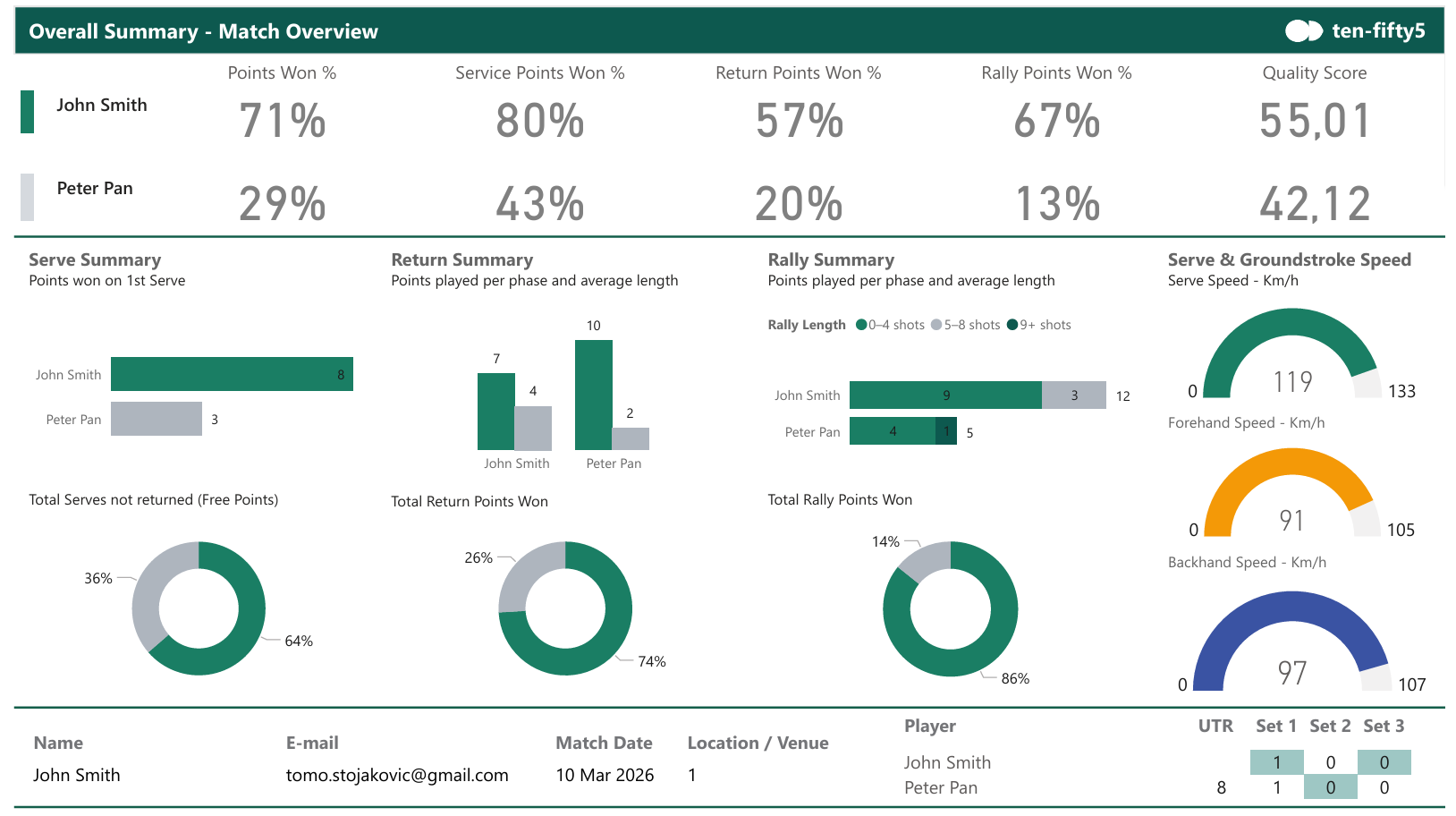
Tennis match analysis is the systematic study of a tennis match using data — every point, every shot, every pattern — to understand why you won or lost and what to work on next. It's the difference between "I felt slow on my second serve today" and "your second-serve win rate dropped from 62% to 41% when you served to the deuce-court body."
The first version is a feeling. The second is a fact you can train against.
Serious match analysis goes deeper than a scoreboard. It tracks placement, depth, speed, rally length, shot selection, and patterns across every point. The same approach has been standard in football, basketball, and baseball for years. Tennis is finally catching up — and AI has dropped the cost from "academy budget" to "free first match."
What gets analysed
A complete match analysis breaks your performance into four layers:
Serves and serve patterns
Every serve is plotted by zone (T, body, wide), speed, spin, and outcome. You learn things like:
- Your first-serve percentage out wide on the deuce side vs the ad side
- Your double-fault rate when serving from behind in the score
- Which serve placement actually wins you free points
- How your serve breaks down on big points vs filler points
For most club players, the serve is the single biggest leverage point — and the most under-analysed. You probably have a "money serve" you don't realise you're avoiding.
Rally patterns and shot selection
How long do your average rallies go? Do you win more 1–4 shot rallies (aggressive, big-server style) or 5+ shot rallies (consoler, counterpuncher)? When you're in a baseline exchange, do you go cross-court 80% of the time? Is your forehand actually your strongest shot, or just your most-used one?
Rally analysis surfaces patterns you can't feel in real time. Most players have a default behaviour pattern they fall into under pressure — one that an opponent will find and exploit within a set if they're paying attention.
Errors, winners, and forced errors
A simple count of unforced errors vs winners tells a coarse story. Real analysis breaks errors down by stroke (forehand vs backhand), location (deep vs short), and rally context (1st-shot, mid-rally, on the run). The pattern of how you lose points tells you what to drill — defensive footwork, forehand stability, or shot selection on the run.
Court positioning and movement
Where do you actually stand when you're not hitting the ball? Where do you recover to between shots? How fast is your split step? Modern analysis maps your average position throughout each rally and surfaces patterns like "you drift left after every wide-forehand return" — small habits with big match consequences.
Why this matters
The myth: "I'm not pro level, I don't need data — I just need to play more."
The truth: club players benefit more from match analysis than pros do. Pros already have feedback loops everywhere — coaches, hitting partners, video reviewers, peer matches. They know what's wrong because the same problems show up across hundreds of weekly hours.
You play once or twice a week. You don't have a coach taking notes courtside. You replay key points in your head on the drive home and remember three of them — usually the dramatic ones, not the structurally important ones. You probably don't know whether your real weakness is your second-serve return or your deep-rally backhand, and so you can't drill the right thing.
Match analysis cuts through that. After one match you know:
- Which exact shot is leaking points
- Which rally bracket you lose most often (1–4 shots, 5–8, 9+)
- Whether your loss came from execution (errors) or selection (going for the wrong shot)
That's three weeks of training, prioritised correctly, from one upload.
How match analysis used to be done
Until recently, you had two options.
Option 1: Hire a coach to chart your match by hand. A trained tennis analyst watches the video back and tags each point. This is what ATP and WTA players use. Cost: $200–$500 per match. Turnaround: 2–5 days. Quality: excellent. Accessibility: zero, for anyone outside professional tour.
Option 2: Watch the video back yourself. This sounds free, but you're watching three hours of video to find out what you already half-suspected. Most players try this once, get bored 20 minutes in, and never finish. The detailed patterns require structured tagging — exactly what gets tedious in a hurry.
That's why match analysis stayed locked up in the pro game for thirty years. The tooling didn't exist for the rest of us.
How AI is changing the game in 2026
Computer vision changed everything. Modern AI models can watch a tennis match video and automatically:
- Detect every shot and which player hit it
- Track ball trajectory and bounce location
- Identify stroke type (forehand, backhand, serve, volley, slice)
- Reconstruct point structure (which shot ended the point and how)
- Build placement heatmaps and rally distributions
- Compare patterns over time across all your uploaded matches
What used to take an analyst 3 hours per match now takes a GPU pipeline 1–2 hours. And because AI doesn't get tired, the per-shot accuracy is consistent across the entire match — including the bottom of the third set when human analysts start drifting.
Layer on top of that: AI coaching. Once the data exists, a model can read it like a coach would and tell you what to work on. Not "improve your forehand" — but "your second-serve win rate to the deuce-court body dropped 18 points compared to last month; here's the drill to fix it."
That second layer — AI grounded in your data — is what separates 2026's tools from the static dashboards of 2022.
How Ten-Fifty5 does it differently
A few things separate Ten-Fifty5 from the camera-locked apps and stroke-only tools out there:
- Any camera input. iPhone, Android, GoPro, DSLR, club facility camera — if it records video, we analyse it. No special hardware. No mounting bracket. No Apple-only lock-in.
- End-to-end automated analysis. Upload a match, walk away, get your full dashboard within a couple of hours. No tagging, no manual review, no waiting on a human analyst.
- AI coaching grounded in your data. Most "AI coaches" give you generic tennis advice. Our coach reads your specific match history and answers questions like "what should I work on for my Saturday match?" with answers tied to your actual numbers.
- Longitudinal tracking. Every match adds to your performance trend. See your serve T-zone accuracy across six months. Watch a backhand error rate drop as you drill. Real before/after, not vibes.
- One platform, three products. Match Analysis + Technique Analysis + AI Coach all bundled in every paid plan. No feature paywalls.
Getting started with your first match analysis
The fastest way to understand what tennis match analysis can do for your game is to upload one match and look at your own data.
You don't need a fancy camera. You don't need to record from above. A phone on a tripod at the back of the court, baseline height, framing both players — that's enough.
Your first match with Ten-Fifty5 is completely free. No credit card. You get the full Match Analysis dashboard, plus 5 free Technique Analyses for stroke breakdowns. Whatever you generate stays in your account permanently — even if you never upgrade.
Bring one match. We'll find the edge.
Frequently asked questions
What's the difference between tennis match analysis and tennis stats?
Stats are counts (e.g., "32 winners, 28 unforced errors"). Match analysis is the story behind those numbers — which shot leaked the errors, which rally length you lose most often, which serve placement actually wins points. Stats answer "what". Analysis answers "why" and "what to work on next."
Do I need a coach to make sense of my match analysis?
No. Modern dashboards are built for self-coaching — visualisations explain themselves and the AI Coach narrates your data in plain English. That said, if you do work with a coach, sharing your dashboard before a session lets them prepare faster and target the exact shot that's leaking.
How often should I analyse my matches?
For most players, every competitive match is the right answer — that's the data you can't get from a casual hit. Practice matches and tournament matches both work. Once you have 5–10 matches in your history, the trend lines start telling stories that single matches can't.
Will match analysis make me a better player overnight?
No tool will. What it does is tell you the right thing to work on, so the practice you already do gets aimed at the actual gap. Most players see a measurable improvement in 4–8 weeks of data-targeted training versus generic drilling.
See your own game in data
Your first match is free — no credit card. Full dashboard, heatmaps, and AI coaching in a couple of hours.
Analyse my first match free