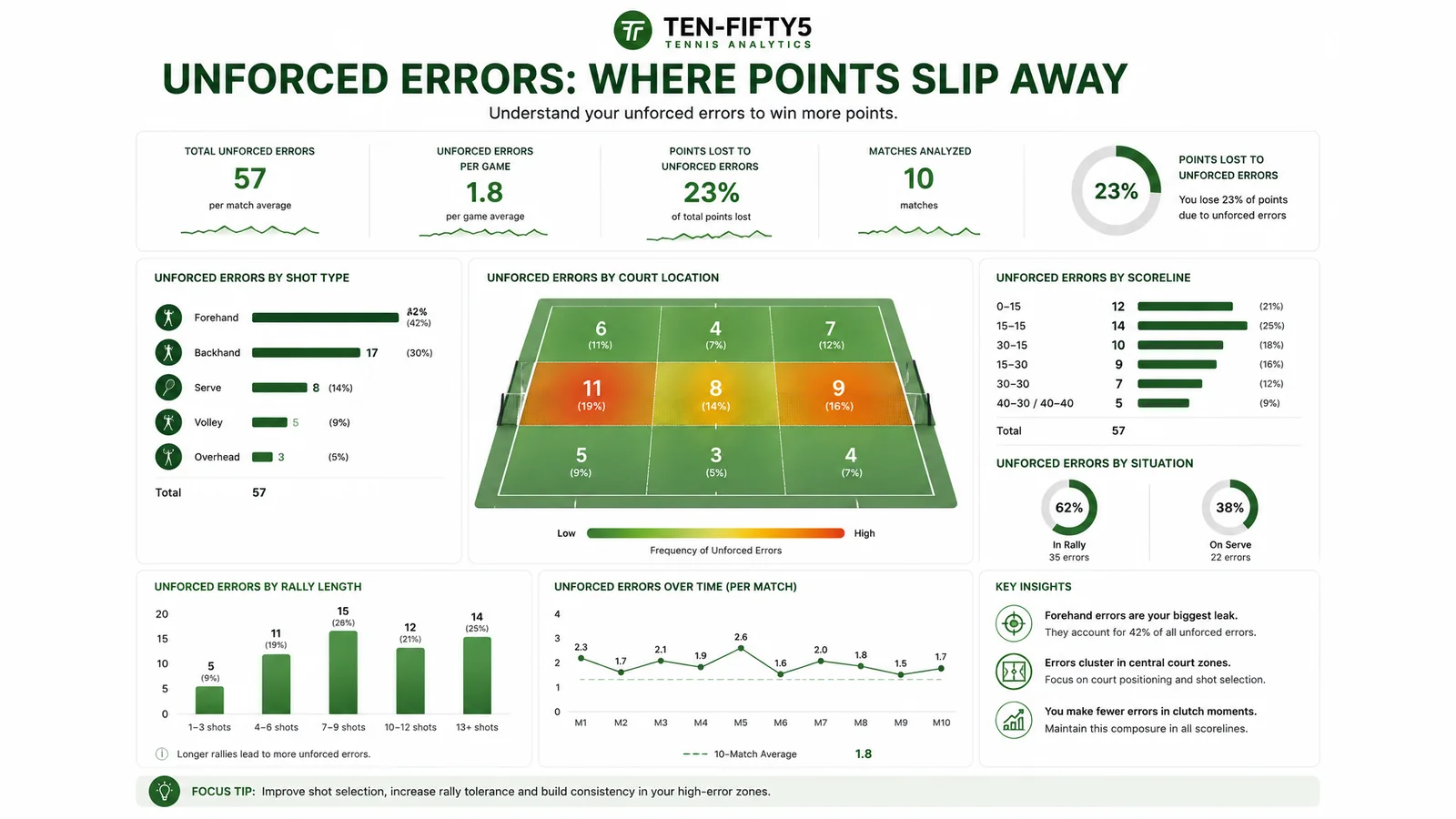
The stat that quietly decides your matches
Watch a professional match and the highlight reel is all winners — the flick pass, the running forehand, the ace out wide. It's easy to believe that's what wins tennis. For club and junior players, it almost never is.
At every level below the tour, the scoreboard is decided by unforced errors. Study after study of amateur tennis reaches the same conclusion: recreational players lose far more points to their own unforced errors than they ever win with clean winners. You don't climb the rankings by hitting more spectacular shots. You climb by handing your opponent fewer free points.
The problem is that errors feel random. One nets a backhand, shrugs, and moves on. But across a few matches, your errors are anything but random — they cluster by shot, by situation, and by score. Once you can see that pattern in your own data, "stop making mistakes" turns into something specific and fixable. This guide shows you how.
Forced vs unforced: get the definition right first
Before you can cut errors, you have to count the right ones. An unforced error is a miss on a ball where you had time, balance, and a genuine chance to make the shot — and still missed. A forced error is a miss your opponent earned: their pace, spin, depth or angle put you in trouble, so the miss was a reasonable outcome of a good shot.
The distinction matters because the two demand opposite responses. Unforced errors are a you problem — footwork, shot selection, patience, focus. Forced errors are an opponent problem — you were outplayed on that ball, and the fix is usually tactical positioning, not "try harder." If you lump them together, you'll either beat yourself up over shots you couldn't make or ignore the self-inflicted ones that are actually costing you.
Good analysis separates them automatically. When Ten-Fifty5 breaks down your match, your unforced errors are isolated from forced ones, so the number you're working to reduce is the number you can actually control.
Where your errors are really coming from
Once you have a clean unforced-error count, the useful work begins: finding the pattern. Four lenses reveal almost everything.
1. By shot
Split your errors by stroke — forehand, backhand, forehand volley, backhand volley, overhead. Almost every player has one shot doing outsized damage, and it's rarely the one they'd guess. You might feel like your forehand is your weapon while the data shows it produces 40% of your unforced errors because you over-hit it. Naming the shot is the first fix; you can't drill a problem you can't see.
2. By rally length
Line your errors up against your rally-length distribution. Do you spray errors in the first three shots — a sign of impatience, going for too much too early? Or does your error rate climb after seven or eight shots, meaning consistency and fitness fade in longer exchanges? These are completely different problems with different training answers, and the rally-length view tells you which one is yours.
3. By score and pressure
This is the one instinct hides from you. Tag your errors by moment — break points, set points, tie-breaks, the second set. Many players are metronomes at 40-0 and suddenly erratic at 30-40. If your unforced errors spike under pressure, the issue isn't your technique at all; it's decision quality and tension when it matters. That's a mental-and-routine fix, not a mechanics fix, and you'd never find it without the data.
4. By direction and margin
Look at where the missed balls were going. Errors piling up into the net usually mean not enough net clearance or margin. Errors sailing long often mean poor footwork and hitting off the back foot. Errors wide often mean over-aggressive targeting near the lines. The direction of the miss points straight at the cause.
Turning the pattern into fewer errors
Diagnosis is worthless without a plan. The research on error reduction in amateur tennis is remarkably consistent on what works — and none of it is "hit harder."
- Add margin, not power. Most club errors come from targeting too close to the lines and the top of the net. Aim a metre inside the lines and a comfortable height over the net. You lose almost nothing in effectiveness and shed errors immediately.
- Fix the feet. A large share of unforced errors start before the racket ever moves — arriving late or crowding the ball. Disciplined footwork and an early split-step put you in balance to execute the shot you meant to hit.
- Train patience deliberately. Impatience is the classic club-level error engine: forcing a winner when the opening isn't there. Practice games where you're not allowed to hit a winner build the consistency muscle and reset your shot-selection instincts.
- Own a between-point routine. A consistent reset between points is the best defence against the pressure-driven errors your score-tagged data exposes. Same routine at 40-0 and at break point.
The key is to attack the specific leak your data named — not errors in the abstract. If your numbers say backhand-into-the-net in long rallies, that's a footwork-and-margin drill on one wing. Targeted beats generic every time.
Measure, don't guess
Here's the encouraging part: unforced errors are the single most improvable statistic in amateur tennis, because you control every one of them. A player who cuts even a handful of self-inflicted errors per set is a meaningfully better competitor — no new weapon required.
But you can only cut what you can see. Counting errors from memory doesn't work; the mind edits, forgets the ugly stretch, remembers the one great winner. Your match footage doesn't forget. Upload a single match and Ten-Fifty5 tags every unforced error, sorts them by shot, rally length, and moment, and lets you ask the AI coach exactly where your errors are concentrated and what to do about them. If you're weighing tools, the pricing plans start with a free first match, and coaches can track error trends across a whole roster from the coaching dashboard.
Winners win points. Cutting unforced errors wins matches. Find your pattern, drill the specific leak, and watch the free points you used to give away turn into games you keep.
See your own game in data
Your first match is free — no credit card. Full dashboard, heatmaps, and AI coaching in a couple of hours.
Analyse my first match free