Every player has felt it. You break serve, the ball gets bigger, and for ten minutes you can't miss. Or the opposite: one double fault, then another game gone, and the set slips away before you've worked out what happened.
So is momentum in tennis real, or is it a story we tell ourselves afterwards? Researchers have checked, on thousands of points. The answer is more useful than "yes" or "no".
What the research found
Momentum is real, but it is small, and it is not the same for everyone.
The best-known study is by Franc Klaassen and Jan Magnus, published in the Journal of the American Statistical Association in 2001. They took all the points from four years of Wimbledon (1992 to 1995) and asked a simple question: is each point independent of the last one? It isn't, quite. Winning a point makes winning the next one a little more likely. The effect is small, small enough that treating points as independent still works well for most purposes.
Then came the part almost nobody talks about: the weaker the player, the stronger the effect. At the top of the game, players reset between points. Further down, one point leaks into the next more often. If you play club tennis, momentum is more of your game, not less.
The same study found something else worth knowing: on the important points, the server wins less often than usual. Serving is the advantage in tennis, and pressure shrinks it. Even at Wimbledon.
Where momentum really shows up: the game after a break
Point to point, the effect is small. Some studies find almost none. Game to game, the clearest swing is after a break of serve.
A study of 141 Grand Slam men's matches, almost 5,000 games, found that a player who has just broken serve is more likely to win the next game too. Its authors argue this looks psychological, not just a case of the better player winning more games.
That matches what every coach says, and now there's a reason to believe it: the game straight after a break is where a match turns.
Not all points are worth the same
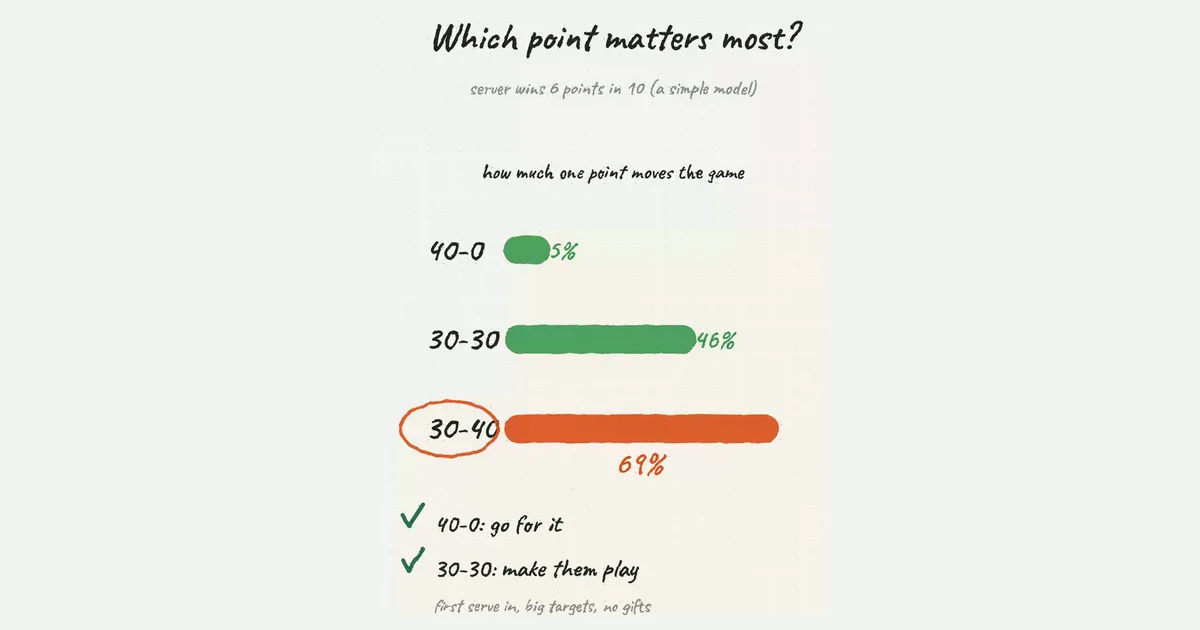
Here's another way to see it, from our own scoring model. Take a server who wins 6 points in 10. How much does winning or losing the next point change their chance of holding the game?
| Score | How much the next point moves the game |
|---|---|
| 40-0 | about 5% |
| 15-15 | about 33% |
| 30-30 | about 46% |
| 30-40 | about 69% |
A simple model: each point at the same chance, 6 in 10 for the server. Not a measurement of any real match.
The point at 30-40 is worth about fourteen times the point at 40-0. Most players play them the same way. They shouldn't.
Four points to play differently
- The game after you break. Slow down. Take your time between points. Get your first serves in, with less pace and bigger targets. This is the game that turns a break into a set.
- The game after you're broken. It's your best chance to break straight back, while the other player is still settling. Make them play every ball.
- 30-30 and 30-40 on your serve. First serve in, big targets, no gifts. Save the risky serve for 40-0.
- Break point against you, as the returner. The server is under more pressure than you are. Don't go for the winning return: get it back, deep and central, and make them hit one more ball.
None of this is a swing change. It's knowing which points matter and playing them on purpose.
How to check your own match
Memory is bad at this. You remember the double fault, not the three games around it. The only honest way to know whether you hold after breaking, or give it straight back, is to look at the match.
Film your next match on a phone, from behind the baseline. Then go game by game: after each break, who won the next game? After each 30-30, who won the point? Our guide to filming your match shows where to put the phone, and our post on break point conversion explains why the big-point numbers are so easy to misread.
Or upload the match to Ten-Fifty5 and see where your points were won, and where they were lost.
Sources
- Klaassen, F. J. G. M. and Magnus, J. R. (2001). Are points in tennis independent and identically distributed? Evidence from a dynamic binary panel data model. Journal of the American Statistical Association, 96(454). Wimbledon 1992 to 1995.
- Separating psychological momentum from strategic momentum: Evidence from men's professional tennis (Journal of Economic Psychology, 2020): 141 Grand Slam men's singles matches, 4,930 games.
- The point values in the table come from Ten-Fifty5's own scoring model (each point at the same chance; the server wins 6 in 10). A model, not a promise.
See your own game in data
Your first match is free, no credit card. The full match analysis; Ted, the AI Coach, comes with any paid plan.