Charting a tennis match by hand is the oldest analysis tool in the sport. A friend, a clipboard and a pen beat any amount of "I felt like I was missing a lot of backhands". The trouble is that most stats sheets ask for far too much, and the person charting gives up by the second set.
This is a sheet that one person can keep up with for a whole match, what each column actually tells you, and the point at which a video does the job better than a clipboard.
The sheet: one line per point
Use one row per point. Five columns are enough:
| # | Server | 1st / 2nd serve | Rally length | How it ended |
|---|---|---|---|---|
| 1 | Me | 1st | 3 | Won: their error |
| 2 | Me | 2nd | 7 | Lost: my error |
| 3 | Me | DF | 0 | Lost: double fault |
| 4 | Me | 1st | 1 | Won: ace / unreturned |
- Server — you or your opponent.
- 1st / 2nd serve — which serve started the point (DF for a double fault).
- Rally length — count the shots, including the serve. Rough is fine: "1", "2-4", "5-8", "9+" works.
- How it ended — won or lost, and how: a winner, an error, an ace or unreturned serve, a double fault.
That is it. Everything else people put on a sheet (shot type, direction, depth, net approaches) is where charting falls apart, because the person holding the pen cannot watch the ball and write at the same time.
What each column tells you
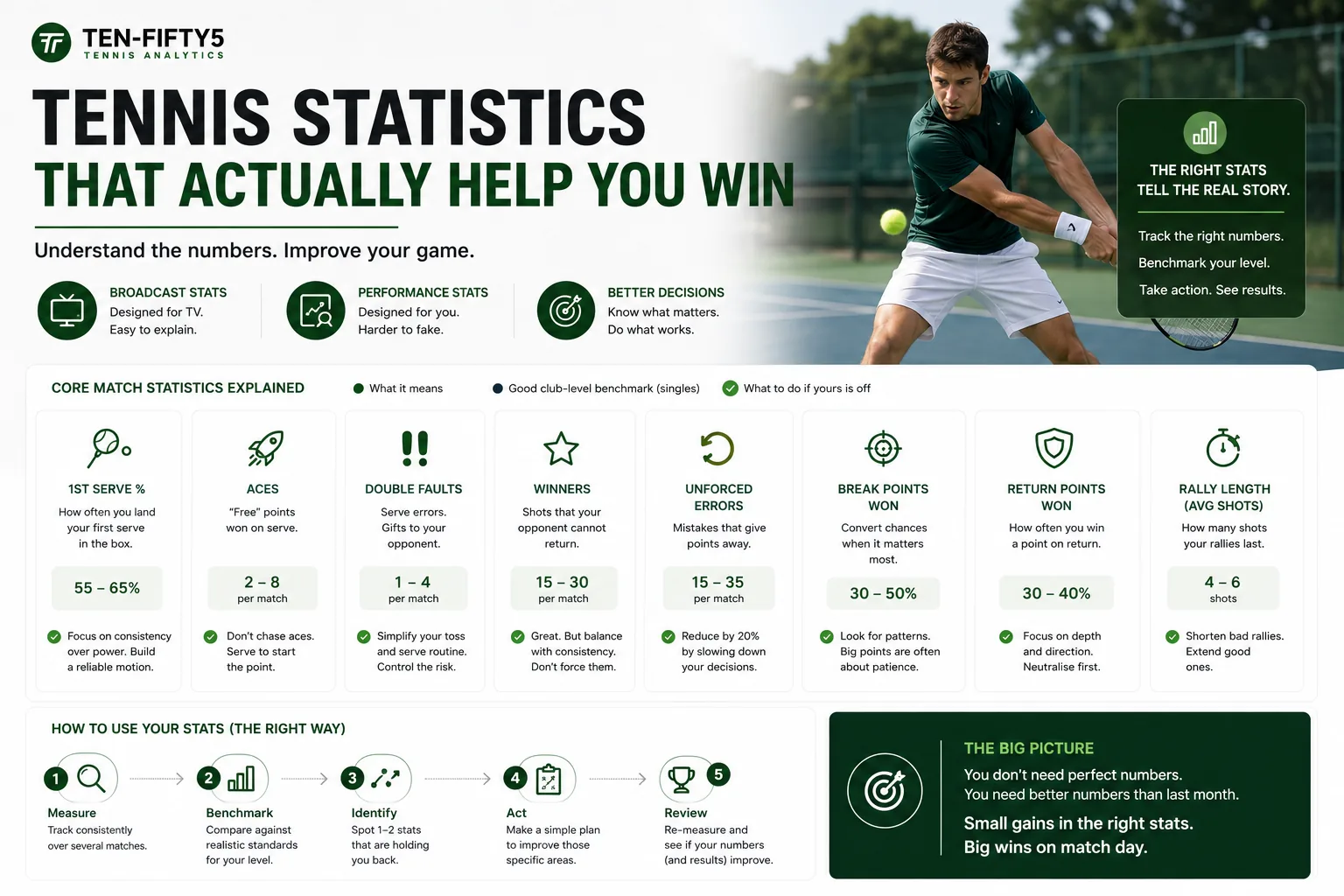
First-serve percentage, and what it is worth. Count the 1sts that went in, then compare the points you won after a first serve with the points you won after a second. If the gap is small, your first serve is not earning you anything, and you can afford to hit it harder. Our guide to tennis stats has club-level ranges for each number.
Rally length is the column most players skip and the most useful one. Split your points won by rally length. Most club players win short points and lose long ones, or the other way round, and the answer changes how you should practise. More on this in what a rally tells you.
"How it ended" separates what you did from what they did. Points you won on their errors feel like your points. They are not a pattern you can rely on next week. Points you lost on your own errors are the ones you can fix: our post on reducing unforced errors shows what to do with them.
Five tips for charting that actually gets finished
1. Chart all of them, not just the interesting points. A sheet that only records the dramatic points tells you about drama. 2. Write the score every game. When you lose your place, the score gets you back. 3. Agree what an "error" is before you start. If your friend and you disagree, the column means nothing. 4. Use one sheet per set. A first set and a third set are different matches, especially for serve percentages. 5. Tally straight after the match, while you still remember which column was which.
Where a clipboard stops
A paper sheet is good at counting. It is bad at where: where your serves landed, where you were standing when a rally turned, which side your errors come from. Nobody can write that down in real time.
That is the gap a video fills. Film the whole match from behind the baseline with the whole court in frame and the phone still (our filming guide takes two minutes), upload the video, and Ten-Fifty5 turns it into serve placement heatmaps, return and rally statistics and an 18-KPI scorecard you can compare match to match. It works from any phone, iPhone or Android, through the browser, with nothing to install.
FAQ
What is the most important stat to chart in tennis? Points won by rally length. It is the one stat that tells you what kind of points to play and what kind to practise.
Can one person chart a whole match alone? Yes, with five columns and rough rally counts. Add shot type or direction and it stops being possible.
Is there a free tennis match stats app? Your first match analysis on Ten-Fifty5 is free, with no credit card: you upload a video instead of charting by hand.
How many matches should I chart before I trust the numbers? Four or five. One match tells you about that match; a pattern needs repeats.
Analyse your first match free — any phone, no card.
See your own game in data
Your first match is free — no credit card. Full dashboard and heatmaps; the AI coach comes with any paid plan.
Analyse my first match free