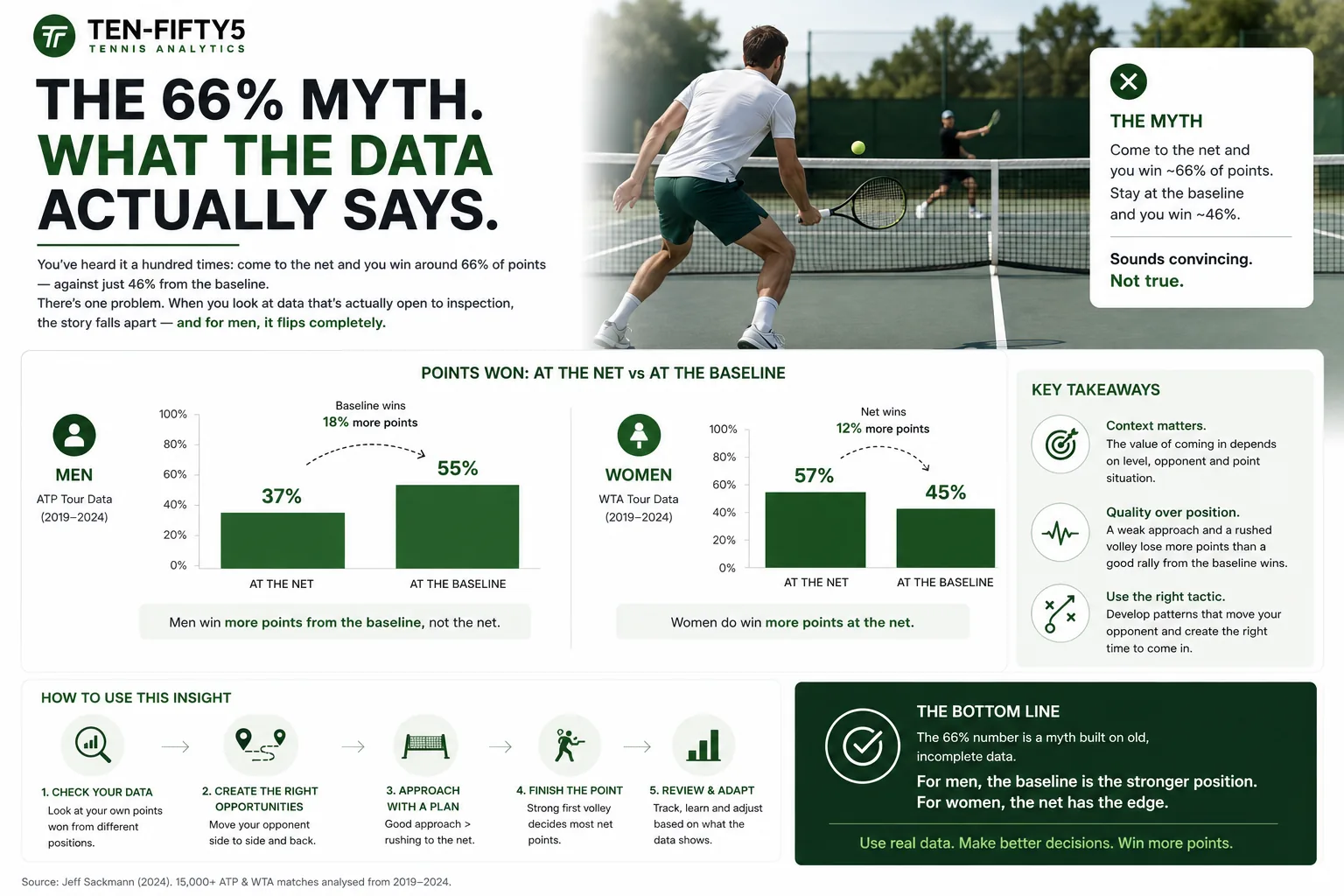
You have heard the number a hundred times. Come to the net, the coaching goes, and you win around 66% of points — against just 46% from the baseline. It gets repeated in clinics, printed in magazines, and quoted as though the argument is over.
There is one problem with it. When you look at data that is actually open to inspection, the story falls apart — and for men, it flips completely.
What the open data shows
On the men's tour, from charted match data anyone can go and check:
- Serve-and-volley: 66.8% of points won
- Staying back at the baseline: 72.2%
Staying back wins more often. That is the opposite of what "net wins two-thirds" implies.
On the women's tour, coming in does hold an edge — 62.7% against 60.9% — but it is a slim one, nothing like the landslide the myth promises.
The famous "66% versus 46%" figure comes from secondary sources with no dataset you can inspect. When a memorable statistic and a checkable one disagree, side with the one you can check.
Why the myth exists: selection bias
This is the important part, and it is worth more to your tennis than the numbers themselves.
Players do not come to the net at random. They come in on their best balls — behind a strong approach, when the opponent is already stretched, off a short ball that begged to be attacked. Nobody sprints forward on a deep, heavy ball to their backhand corner.
So the high win rate at the net is not caused by the net. It is caused by the quality of the ball they chose to come in on. Measure the outcome and you are really measuring their shot selection.
The net did not win the point. The great approach did — and they would probably have won it from the baseline too.
This is one of the most common traps in sports statistics: a number that describes who chose to do something gets read as a number describing what happens when you do it. Once you see it, you notice it everywhere.
So should you come in? Yes — for the right reason
None of this means stay back. It means come in for a reason that survives scrutiny.
Net play genuinely wins when the approach is good. Its real value is not some magic property of standing close to the net. It is that a strong approach shortens the point and pressures your opponent into an error while they are already off balance.
Rush forward on a mediocre ball chasing a two-thirds win rate that was never real, and you will get passed all afternoon. Come in behind a ball that has already put them on the back foot, and the net finishes what your approach started.
The practical test is simple: is my opponent in trouble before I move? If the answer is no, the net is not going to rescue the point.
Where to approach, and why it is not "always down the line"
The other half of net play is coverage — and here the usual advice is also an oversimplification.
Out wide, approach down the line. It is the shortest path in, it leaves you the least court to cover, and it gives the opponent only the long crosscourt pass. This is the default, and the geometry behind it is real: you are buying position by accepting a slightly higher net on a slightly shorter flight.
From the middle, crosscourt into the corner can be right. With no sideline near you there is no line to shorten, and from a central net position you can still cover both passes. Louis Cayer teaches this as the correction to "always approach down the line", and it is worth internalising: read where the ball is, do not just obey the slogan.
That distinction — where you receive the ball decides where you send it — is the difference between a coached net game and a hopeful one.
What to actually measure
If you want to know whether coming in is working for you, the tour averages are close to useless. Your own numbers are not.
Three things worth tracking across a handful of matches:
- Your win rate at net, split by approach quality. Separate the points where the opponent was already stretched from the ones where you came in on a neutral ball. If the second group is a bloodbath, you have a selection problem, not a volleying problem.
- How you lose the point when you lose it. Passed down the line means a coverage error — you approached to the wrong side or drifted after your own shot. Passed crosscourt from a stretch means the approach was not good enough.
- How often you come in at all. Plenty of club players believe they "never win at the net" on a sample of four points across three matches. That is not evidence of anything.
This is the sort of question match analysis answers directly, because it separates outcome from selection — which is exactly the distinction the 66% myth collapses.
Frequently asked questions
Is it true that net play wins 66% of points? No. That figure has no public dataset behind it and is selection-biased by construction. On open charted data, men's serve-and-volley wins 66.8% while staying back wins 72.2%.
Does that mean I should never come to the net? No — it means come in behind a good approach rather than to chase a statistic. The net rewards good shot selection, not bravery.
Why do the pros come to the net so rarely then? Modern racquets and strings make passing shots far easier than they were in the serve-and-volley era. The net has not stopped working; the cost of getting there has gone up.
Should I always approach down the line? Out wide, yes — least court to cover. From the middle, a crosscourt approach into the corner can be the better ball, because you can still cover both passes from a central net position.
How many matches before I can trust my own net numbers? Four or five. A single match will not contain enough net points to mean anything.
The honest version
Net play is not a shortcut and it is not a myth. It is a finisher.
The number that made it famous was measuring the balls players chose to attack, not the act of attacking. Strip the selection bias out and what remains is quieter and far more useful: come in on the right ball and you win; come in to chase a statistic and you lose.
See what a full match analysis looks like — your first match is analysed free.
See your own game in data
Your first match is free — no credit card. Full dashboard, heatmaps, and AI coaching in a couple of hours.
Analyse my first match free