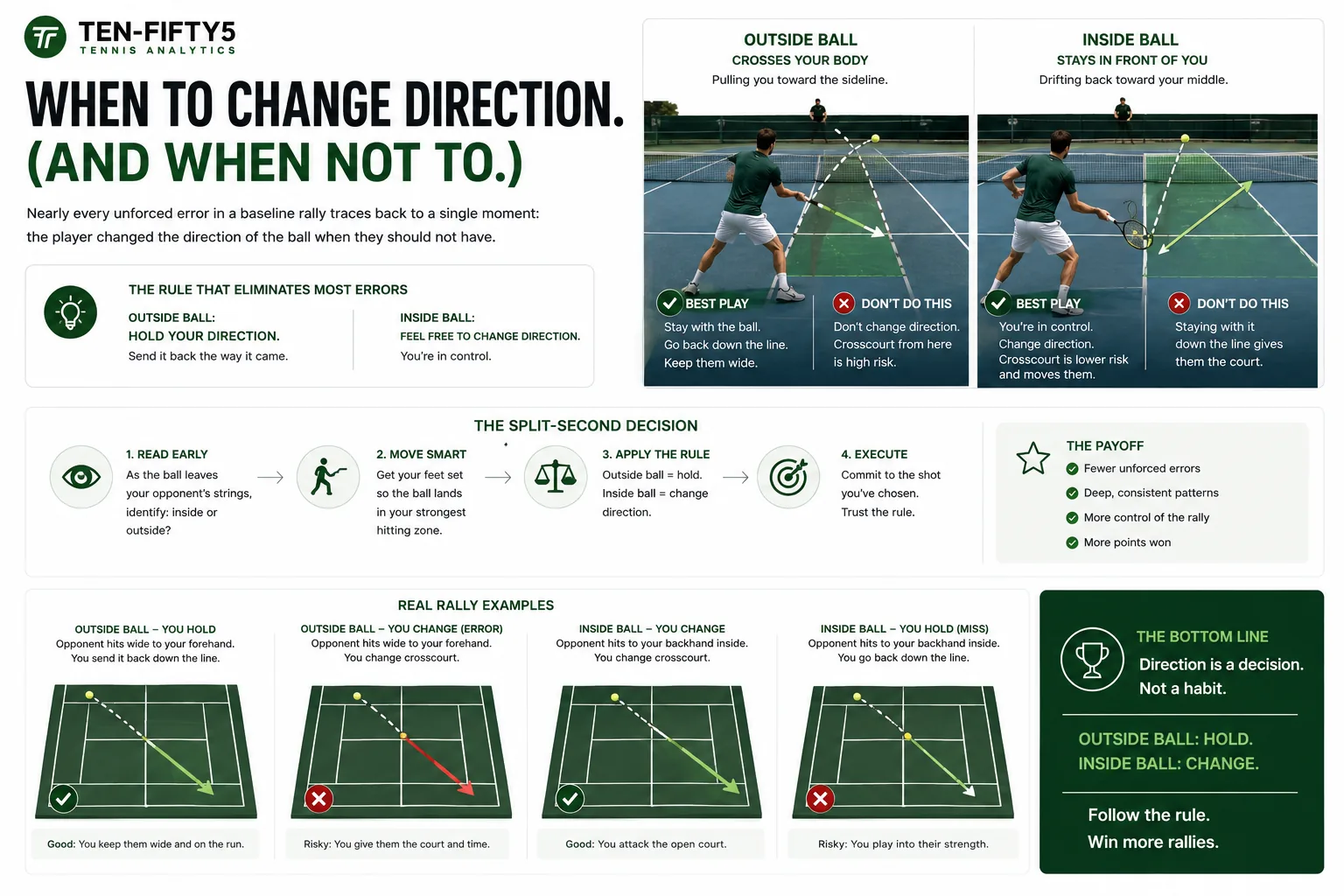
Nearly every unforced error in a baseline rally traces back to a single moment: the player changed the direction of the ball when they should not have.
The down-the-line drive off a wide, deep ball. The crosscourt flick from a full stretch. It feels aggressive. It is actually the most reliable way to lose a rally point — and there is a rule that all but eliminates it.
The one distinction that matters: inside ball or outside ball
The rule comes from coach Paul Wardlaw, and it turns on a single read.
- An outside ball crosses your body on its way in. It is pulling you toward the sideline.
- An inside ball stays in front of you, drifting back toward your middle.
That is the whole diagnosis. Everything else follows from it.
On an outside ball, hold your direction. Send it back the way it came — almost always crosscourt.
On an inside ball, you are free to change direction and go the other way.
Why changing on an outside ball is so expensive
When you redirect an outside ball, the physics turn against you at the same moment, in two ways.
You are hitting a ball that is already moving away from you, so you have to generate the change of direction yourself rather than borrowing it from the incoming ball. And you are sending it over the higher part of the net into the shorter court — the net is roughly six inches taller near the sidelines than at the centre strap, and the straight line up the court is shorter than the diagonal.
Higher net, shorter court, worse balance, and no help from the incoming ball. That is four margins spent at once, which is why it is the lowest-percentage shot in tennis dressed up as aggression.
Holding your direction, by contrast, costs nothing. The ball keeps the net height and court length it arrived with. You are not paying for anything.
The four conditions for a green light
Changing direction is not forbidden — it is earned. Four things have to be true at once:
1. Short ball — it has landed inside the baseline 2. Inside ball — it is drifting toward your middle, not dragging you wide 3. You are on balance — set, not reaching, moving forward rather than sideways 4. You drive it straight down the court — not for a sharp angle
Meet all four and the down-the-line finish is genuinely high-percentage. Take it.
Miss any one of them and hold your direction instead. Send it back crosscourt, recover, and wait for a better ball. Changing direction there is the error you keep making.
The redirect pays a taller net and a shorter court simultaneously. That bill is only affordable on the short, high ball you are already moving forward to.
The myth this replaces: "keep them guessing"
Unpredictability sounds clever. It wrecks more club rallies than any other idea in tennis.
Changing direction in order to be surprising means changing it on the wrong balls — the deep, wide, outside ones — which is precisely the low-percentage error the rule exists to prevent. You end up gambling on your worst shots to create variety you did not need.
You do not need to be unpredictable. You need to be right. Change direction when the ball earns it — short, inside, on balance — and you will be plenty dangerous without ever gambling.
How it fits with the rest of the baseline game
This rule does not stand alone. Pair it with the crosscourt habit and the entire baseline game collapses into one decision.
Crosscourt is home — it is where you rally, patiently, holding your direction on every outside ball. Then a short, inside ball arrives, you are set and balanced, and that is your green light to change direction and finish.
Coaches call it aggressive patience. It is not passivity. It is refusing to pay for a redirect until the ball hands you the money.
Spotting it in your own matches
The frustrating thing about this error is that it does not feel like an error while you are making it. It feels like initiative. The ball goes into the net or wide, you tell yourself you were unlucky, and you do it again two points later.
What makes it visible is looking at your errors by ball type rather than by count. Group your unforced errors and ask a single question of each: was I changing the direction of the ball? If most of your rally errors are redirects, you do not have a technique problem — you have a decision problem, and it is a far quicker fix.
Our guide to reducing unforced errors with data covers why the error type matters far more than the error count, and the attack, neutral and defence split shows whether you are drifting into these decisions under pressure.
Frequently asked questions
What is an outside ball in tennis? A ball that crosses your body on its way in, pulling you toward the sideline. The rule says hold your direction on these — send them back the way they came.
What is an inside ball? A ball that stays in front of you and drifts back toward your middle. These are the ones you are allowed to change direction on.
Should I never hit down the line? You should hit down the line often — but off short, inside balls taken on balance, not off deep wide ones. Down the line is a reward, not a habit.
Does this apply on the backhand too? Yes. The rule is about the ball's path relative to your body, not which wing you are hitting with.
Is this the same as "hit crosscourt when in trouble"? It is the reason that advice works. Holding direction on an outside ball usually means crosscourt, and the geometry of the crosscourt is what makes it safe.
The rule in one line
Hold your direction on anything that stretches you. Change it only on a short, inside ball you have walked into.
Install that until it is automatic and a large share of your rally errors simply stop happening — not because you are hitting better, but because you have stopped attempting the shot that was never on.
See what a full match analysis looks like — your first match is analysed free.
See your own game in data
Your first match is free — no credit card. Full dashboard, heatmaps, and AI coaching in a couple of hours.
Analyse my first match free