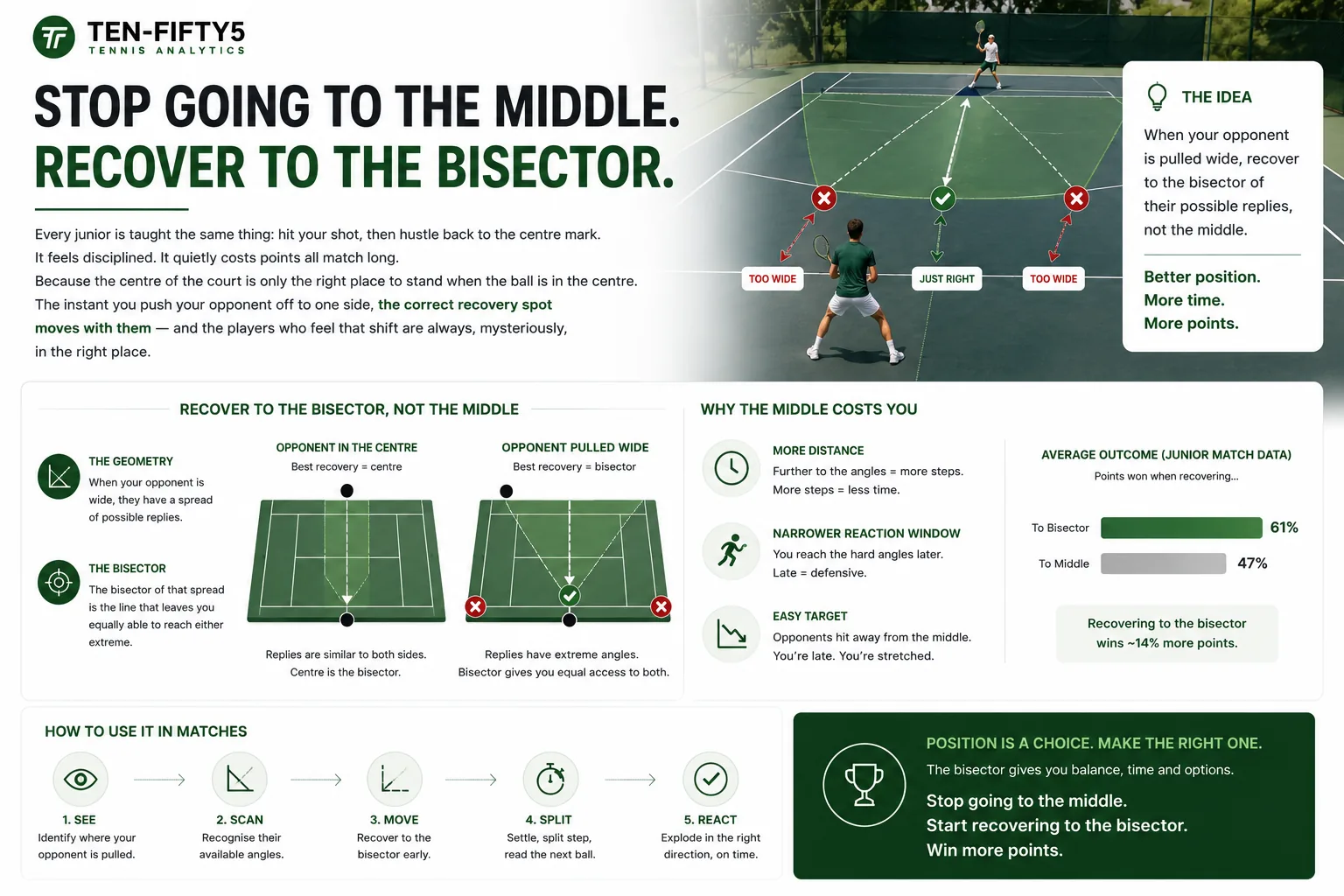
Every junior is taught the same thing: hit your shot, then hustle back to the centre mark.
It feels disciplined. It quietly costs points all match long.
Because the centre of the court is only the right place to stand when the ball is in the centre. The instant you push your opponent off to one side, the correct recovery spot moves with them — and the players who feel that shift are always, mysteriously, in the right place.
Recover to the bisector, not the middle
Here is the geometry.
When your opponent is pulled wide, they have a spread of possible replies — from a sharp crosscourt angle at one extreme to a ball straight down the line at the other. The perfect place to stand is the bisector of that spread: the line that leaves you equally able to reach either extreme.
And when the opponent is off to one side, that bisector is not the centre mark. It sits a step toward the side of the court the ball is on.
Retreat dutifully to the middle and you have left yourself equidistant from two replies that are not equally likely — and a half-step slow to the one that actually comes back.
This is measured, not a coaching hunch
That is the part that makes this worth trusting.
In one of the most rigorous studies ever done on court movement, researchers tracked 5,679 Hawk-Eye shots and found that elite players recover almost exactly to this geometric bisector — within about 0.93 metres — and that it was the single best predictor of where they moved, for eighteen of the twenty-three players measured.
The best in the world are not running to the middle. They are running to the bisector, and it is measurable to within a metre.
It is worth pausing on how unusual that is. Most tactical advice in tennis is inherited wisdom with no dataset behind it. This one has peer-reviewed ball-tracking data and a number attached — which is why it belongs in the small set of things you can simply believe.
And what our own matches say
That study is elite players. We measured the same thing on our own corpus — 1,758 rally shots across the 14 matches that carry enough of both behaviours to compare.
Recovering toward the bisector wins more points than recovering to the middle in 10 of those 14 matches, by a median of 6 percentage points. Pooled across every shot it comes out at 56% against 52%.
So the effect is real, and it points the same way as the Hawk-Eye data. But it is a smaller edge at club and junior level than the elite numbers might lead you to expect, and it is not universal — four of the fourteen matches go the other way.
Treat it as a tendency worth playing, not a law. The geometry is sound and the direction is consistent; the size of the prize is a step, not a transformation.
The practical version
You do not need the maths. You need one instruction:
Recover toward the ball, not to the middle.
Hit your opponent wide and you take a couple of steps back toward the centre — but not all the way. You stop short, shaded toward the side you just hit to, ready for the reply that is most likely to come back.
Do it well and you will never feel rushed. Do it wrong — sprinting dutifully to the centre mark — and you will spend every point a half-step late.
That half-step is the difference between arriving set and arriving stretched. And arriving stretched is what forces the low-percentage shot in the first place, which is how a movement error becomes a shot error and gets blamed on your forehand.
Why "get back to the middle" survives
It survives because it is nearly right, and because it is easy to say.
When rallies are neutral and both players are hitting from around the centre, the bisector is roughly the centre mark. The instruction works for the first few shots of most rallies, which is enough for it to feel true.
It breaks exactly when the point gets interesting — when someone has finally been moved. That is the moment the advice becomes actively harmful, and it is also the moment nobody is thinking about their recovery position.
How to see it in your own tennis
Movement errors are the hardest thing to self-diagnose, because you experience them as shot errors. You feel late, you reach, the ball goes long, and you conclude your timing was off.
Two things make the pattern visible:
Where you are standing when the point turns against you. If you are repeatedly caught wrong-footed by the reply after you hit a wide ball, you are over-recovering to the centre — you are not being out-hit, you are being out-positioned.
Court position through the rally. Players who camp deep and central are usually being disciplined in exactly the way that costs them. Our guide to court position and the rally stats that matter covers what to look for.
There is a neat link here to the rest of the baseline game, too. Recovering to the bisector is what lets you hold your direction on an outside ball rather than gambling on a redirect — you arrive early enough to have a choice.
Frequently asked questions
Where should you recover to after hitting a tennis shot? To the bisector of your opponent's possible replies — which shifts toward the side of the court the ball is on, not the centre mark, whenever you have moved them wide.
Is "recover to the centre" wrong? It is correct only when the ball is in the middle. Push your opponent into a corner and the correct recovery spot moves toward that corner with them.
How far off centre should I be? The research measured elite players recovering within about 0.93 metres of the geometric bisector. Practically: a step or two toward the side you hit to, not all the way home.
Does this apply to doubles? The underlying geometry does, but doubles adds a partner and a net player, so the bisector you are covering is a shared one. This rule is written for singles.
What if I have hit a weak ball? Then their spread of replies is wider and the bisector shifts less usefully — which is another reason depth matters. A short ball costs you position twice: once in the reply you face, and once in the recovery you cannot make.
Fix the most common movement leak in the game
After a wide ball, recover toward the ball. Not to the centre mark.
It is one of the very few adjustments in tennis that costs nothing, requires no new technique, and is backed by ball-tracking data on thousands of shots. Most players can install it in a single practice session and feel the difference immediately — not because they are moving faster, but because they have stopped running to the wrong place.
See what a full match analysis looks like — your first match is analysed free.
See your own game in data
Your first match is free — no credit card. Full dashboard, heatmaps, and AI coaching in a couple of hours.
Analyse my first match free