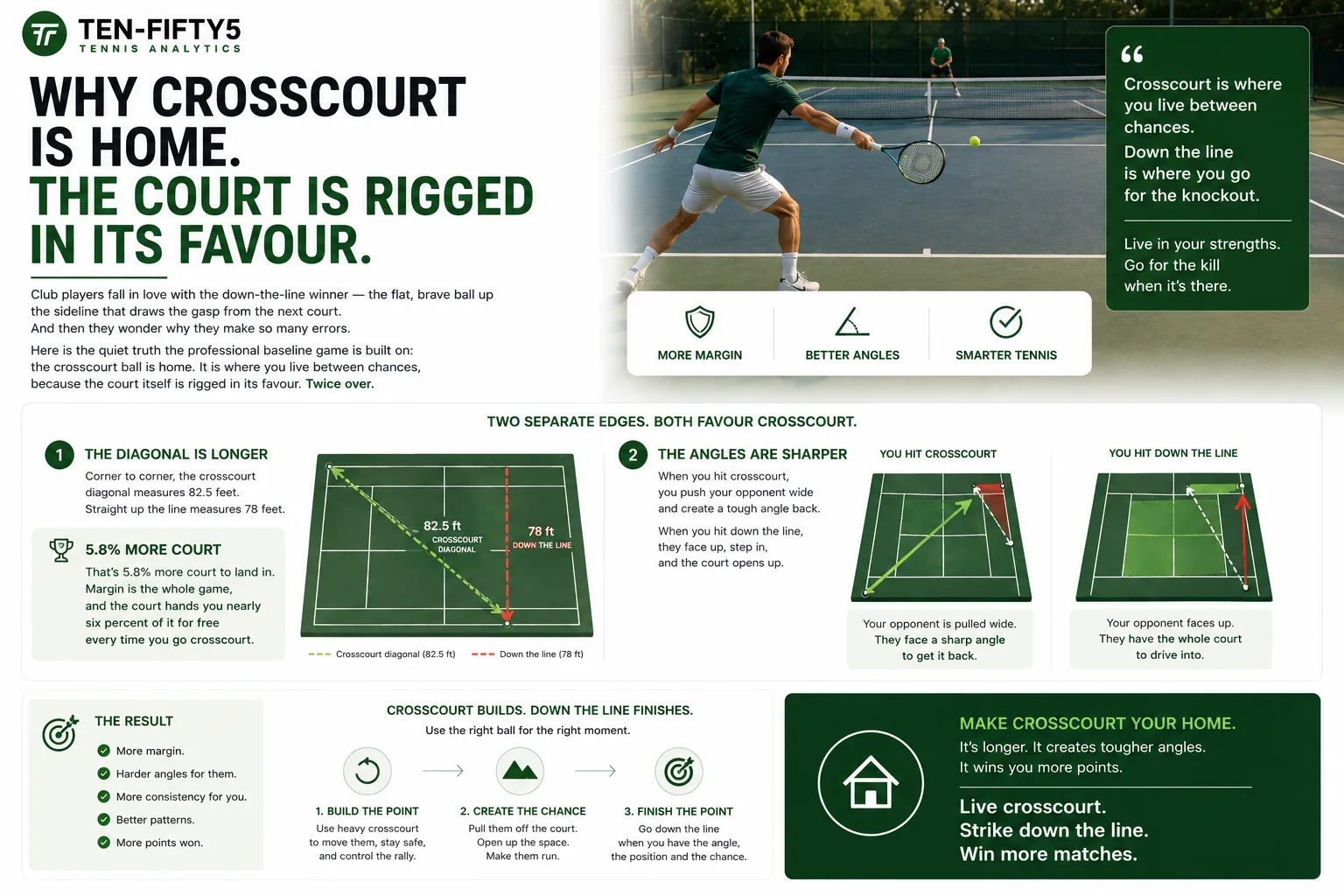
Club players fall in love with the down-the-line winner — the flat, brave ball up the sideline that draws the gasp from the next court. And then they wonder why they make so many errors.
Here is the quiet truth the professional baseline game is built on: the crosscourt ball is home. It is where you live between chances, because the court itself is rigged in its favour. Twice over.
Two separate edges, and they are worth keeping separate
Almost everyone knows crosscourt is "safer". Far fewer can say why, and the why is what lets you trust it at 4-4 in a third set.
1. The diagonal is longer
Corner to corner, the crosscourt diagonal measures 82.5 feet. Straight up the line measures 78 feet.
That is 5.8% more court to land in. Margin is the whole game, and the court hands you nearly six percent of it for free every time you go crosscourt.
2. The net is lower in the middle
The net is six inches lower at the centre strap than at the posts — about 15%.
A crosscourt ball crosses near that low middle. A down-the-line ball has to clear the higher, meaner part near the sideline.
Stack the two and the crosscourt is simply a bigger, safer target with more room for error. Not marginally. Structurally.
The "ten percent longer" myth
You will hear that the crosscourt is about ten percent longer than the down-the-line. It is repeated constantly and it is muddled.
The diagonal is 5.8% longer, not ten. The "ten percent" quietly smuggles in the separate gift of the lower net and presents it as extra distance.
Why fuss over a few percentage points? Because understanding that there are two distinct edges — length and net height — is what lets you trust the shot under pressure, and know exactly what you are giving up the moment you go down the line.
If you think crosscourt is safer because "it's longer", you have one reason. If you know it is safer because it is longer and crosses a lower net, you have two — and you understand precisely which one you are spending when you redirect.
Aggressive patience: what crosscourt is actually for
This is the foundation of what good players call aggressive patience.
Rally crosscourt. Build depth and width. Wait. And only when a short ball arrives do you step in and change direction to finish.
Crosscourt is not where you win the point. It is where you earn the right to.
That distinction matters because "hit crosscourt" gets heard as "play safe", and it is not the same thing. You are not being cautious — you are choosing to compete on the half of the court where the geometry pays you, until the ball gives you a reason to leave.
The exact rule for when you are allowed to leave is the inside/outside read: hold your direction on an outside ball, change only on an inside one. Down the line is a reward for a short ball, not a habit.
Aim at the low middle
One practical adjustment follows directly from the second edge, and most players never make it.
When you hit a crosscourt drive, aim to cross the net near its low middle, not over the part of the net nearest your target corner. That is where your margin physically lives. Players who aim their crosscourt over the sideline-end of the net are paying the down-the-line net tax on a crosscourt shot and getting none of the benefit.
What this looks like in your own match data
Two numbers tell you whether you are actually living crosscourt or just believing you are.
Your crosscourt-to-down-the-line ratio in rallies. Most club players hit down the line far more often than they think, and almost always off the wrong ball. Seeing the split is usually a surprise.
Where your rally errors happen. If the down-the-line attempts are producing a disproportionate share of your errors relative to how often you hit them, the geometry is billing you and you have not noticed.
Neither is visible from memory — you remember the down-the-line winner and forget the four that missed. That is what reading your own rally patterns is for, and the full stats guide covers which other numbers are worth your attention.
Frequently asked questions
Why is crosscourt safer than down the line in tennis? Two reasons that stack: the crosscourt diagonal is 5.8% longer than the down-the-line, and it crosses the net roughly six inches lower at the centre than at the posts. More court to aim into, over a lower obstacle.
Is the crosscourt really ten percent longer? No. The diagonal is 5.8% longer. The "ten percent" figure conflates the extra length with the separate advantage of the lower net.
How much lower is the net in the middle? About six inches — roughly 15% lower at the centre strap than at the posts.
Should I hit every ball crosscourt then? Crosscourt is the default, not the only option. You leave it when a short, inside ball lets you change direction on balance — that is when the redirect becomes affordable.
Does this apply to slice and defensive balls too? Yes, and more so. The worse your position, the more you need the margin, which is why holding direction crosscourt is the standard answer from defence.
Take the free margin
Tennis is a game of margins, and the court hands you one for nothing every time you hit crosscourt.
Build there, live there, and let your opponent be the one tempted into the low-percentage line.
See what a full match analysis looks like — your first match is analysed free.
See your own game in data
Your first match is free — no credit card. Full dashboard, heatmaps, and AI coaching in a couple of hours.
Analyse my first match free